
Por qué el coche favorito de Jay Leno era uno a vapor.
Anuncios
Jay Leno’s Favorite Car isn’t a Ferrari, a Bugatti, or even one of the modern electric monsters that dominate headlines.
It’s a 1925 Doble steam car—quiet, deliberate, and still capable of turning heads in Los Angeles traffic more than a century after it was built.
Most collectors chase rarity or raw speed.
Anuncios
Leno, who has driven nearly every significant machine of the last hundred years, keeps coming back to steam.
There’s something about these cars that refuses to be reduced to numbers on a spec sheet.
They demand presence. They make the driver part of the machinery rather than just its operator.
Have you ever noticed how the most interesting machines are rarely the easiest ones to live with?
Why Does a 1925 Steam Car Top the List for Someone Who Owns Everything?
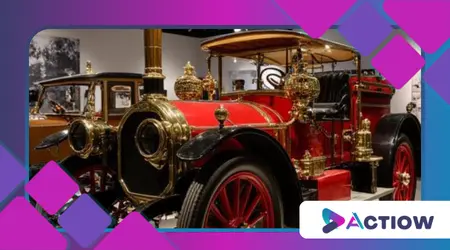
Jay Leno has spent decades behind the wheel of everything from Duesenbergs to Koenigseggs.
Yet when conversation turns to favorites, the Doble surfaces again and again.
It isn’t nostalgia alone. Steam cars operate on a different rhythm—linear, immediate, almost meditative.
The power delivery feels alien to anyone raised on internal combustion.
Torque arrives the instant you open the throttle, without waiting for revs or shifting gears.
That seamless pull never loses its novelty, even after thousands of miles in high-strung exotics.
Leno often mentions the engagement factor. You don’t simply start a steamer and forget it.
You monitor pressures, watch water levels, listen to the burner.
The relationship stays active. In an age when cars increasingly drive themselves, that hands-on dialogue feels quietly radical.
++ ¿Por qué al Citroën DS lo llamaban “La nave espacial sobre ruedas”?”
How Close Did Steam Come to Defining the American Automobile?
At the dawn of the automotive era, the future was far from settled.
In 1900, steam-powered vehicles accounted for roughly 40 percent of American car production—outpacing both electrics and the noisy, hard-to-start gasoline machines that would eventually dominate.
Steam offered real advantages for the time: strong low-speed torque for hills and city streets, relative silence, and no hand-cranking on frosty mornings.
Doctors and businessmen favored them because they simply worked when you needed them.
The technology carried the quiet confidence of established industrial power—locomotives and factories had run on steam for decades.
Of course, limitations existed. Early models took time to raise pressure, and water consumption limited range.
Yet for a brief window, steam felt like the refined choice in a rough world.
The internal combustion engine only pulled ahead once mass production, better fuels, and widespread service infrastructure tipped the scales.
++ La tecnología que permite a los coches predecir fallos en los componentes
That near-miss still lingers as one of automotive history’s more intriguing what-ifs.
| Year 1900 Power Source | Approximate Share of U.S. Production | Owner Perception at the Time |
|---|---|---|
| Vapor | ~40% | Smooth, powerful, familiar from industry |
| Eléctrico | ~38% | Quiet and clean, but limited range |
| Gasolina | ~22% | Promising range, but cranky and smelly |
What Sets the Doble Apart as Jay Leno’s Favorite Car?
Abner Doble took steam further than anyone else dared once the industry had largely moved on.
His late Model E cars featured advanced monotube boilers, superheated steam reaching extreme temperatures, and remarkably few moving parts—around two dozen in the engine versus hundreds in contemporary gasoline cars.
++ El impacto oculto del mantenimiento de la conducción urbana en los coches modernos
Jay Leno’s Favorite Car produces roughly 150 horsepower but delivers well over 1,000 foot-pounds of torque at the wheels.
Acceleration feels less like conventional driving and more like being gently shoved forward by an invisible hand.
No clutch. No traditional transmission. Just direct, continuous urge.
The Doble also starts faster than older steamers thanks to electric ignition and refined burners.
Leno has driven his on actual roads, keeping pace with modern traffic without theatrics.
That blend of engineering sophistication and everyday usability—wrapped in 1920s coachwork—makes it stand out even inside a collection full of legends.
How Does the Driving Experience of a Steamer Differ from Anything Built Since?
Imagine merging onto the freeway while the car seems to breathe alongside you.
The burner hums low, pressure builds, and motion arrives without the usual drama of revving or shifting.
It feels closer to piloting a small locomotive than sitting in a modern automobile.
One drive Leno recounts involved pulling away from stoplights in dense Los Angeles traffic.
The Doble glides forward so smoothly that passengers sometimes glance around, wondering where the engine noise disappeared to.
The experience strips away the artificial drama that turbo lag and gear changes add to everyday driving.
Another run highlighted the meditative quality.
On a long straight, the Stanley Steamer in his collection builds speed steadily while the water gauge slowly drops and the pressure needle moves in its own quiet dance.
Driving becomes less about dominating the machine and more about staying in conversation with it.
Jay Leno’s Favorite Car works like a fountain pen in an age of disposable plastic.
You could type faster on a screen, but the ritual of filling the reservoir, choosing the right ink, and feeling the nib glide across paper creates a connection no keyboard can match.
Two Real Drives That Capture Why Jay Leno’s Favorite Car Still Matters
During one trip through Los Angeles, Leno took the Doble out and watched modern drivers do double-takes.
Steam venting gently from the relief valve turned the car into rolling theater.
People who ignore million-dollar supercars stopped to ask questions because the machine looked alive—almost organic—in a sea of silent electrics and rumbling V8s.
On another occasion, he pushed a Stanley Steamer hard enough on the 405 freeway to earn a speeding ticket—the oldest car ever cited there, he likes to note with a grin.
The point wasn’t outright velocity. It was proving that a vehicle from the Woodrow Wilson era could still move with dignity and surprising competence.
That quiet defiance against obsolescence keeps these cars relevant long after their supposed time passed.
These moments reveal something deeper about Jay Leno’s Favorite Car.
It bridges eras without shouting. In a culture obsessed with the newest and loudest, its steady confidence feels like a form of resistance worth preserving.
What Real Challenges Come with Keeping a Century-Old Steam Car on the Road?
Maintenance runs deeper than oil changes. Water quality matters intensely—scale can ruin a boiler in short order.
Burners need careful tuning to vaporize fuel cleanly without leaving soot.
Leno has collected his share of small scars and lessons, including incidents where minor fuel-line issues reminded him that respect for pressure systems is non-negotiable.
Idle time brings its own complications. Seals dry out, systems need periodic exercise. Yet that extra attention forges a stronger bond.
Owners don’t merely possess these cars; they actively steward them across decades.
The reward arrives each time the pressure gauge climbs and the car eases forward.
The effort reinforces why Jay Leno’s Favorite Car occupies such a special place.
Pure convenience has its appeal, but genuine engagement tends to linger longer in memory.
Preguntas frecuentes sobre Jay Leno’s Favorite Car
| Pregunta | Respuesta |
|---|---|
| Does Leno actually drive Jay Leno’s Favorite Car regularly? | Yes—he regularly takes the Doble and other steamers out on public roads, not just for static displays. |
| How long does it take to prepare a Doble for driving? | With its updates, roughly 10–15 minutes from cold, far quicker than many earlier steamers. |
| Are these cars safe by modern standards? | When properly maintained, they prove remarkably reliable; Doble engineering emphasized durability. |
| Why didn’t steam survive against gasoline historically? | Infrastructure, quicker refueling, and the advantages of mass production ultimately favored internal combustion. |
| Could modern materials revive steam power seriously? | Niche applications remain possible, though water management and thermal efficiency would still need creative solutions. |
Jay Leno’s Favorite Car quietly demonstrates that the most compelling machines often refuse to follow the obvious path.
They ask more of their keepers and, in return, offer something harder to quantify than horsepower charts or zero-to-sixty times.
In an era racing toward autonomy and instant gratification, a 1925 steamer that still demands attention and delivers character feels like a necessary reminder of what connection to machinery once meant—and could still mean.
For deeper reading on this corner of automotive history: