
Comprendre la technologie de direction électrique dans les voitures modernes
Annonces
Technologie de direction électrique Elle élimine les colonnes de direction mécaniques traditionnelles, remplaçant les arbres en acier physiques par des signaux électroniques avancés et des actionneurs de précision.
Les ingénieurs automobiles modernes ont conçu cette architecture de pointe pour maximiser l'espace dans l'habitacle, éliminer les vibrations gênantes du volant et personnaliser instantanément la dynamique de conduite du véhicule.
Les constructeurs de véhicules électriques haut de gamme déploient désormais cette innovation sur l'ensemble de leurs flottes de production afin d'offrir une agilité de conduite et des performances de sécurité sans précédent.
Annonces
Comprendre cette révolution électronique permet de comprendre comment les automobiles du futur se dirigeront, réagiront et protégeront leurs occupants lors de manœuvres d'urgence critiques.
Les journalistes automobiles des rédactions du monde entier suivent de près comment les systèmes de direction électronique transforment le ressenti du conducteur au quotidien et la stabilité en virage à haute vitesse.
La suppression de la lourde colonne de direction en métal réduit le poids total du véhicule tout en offrant une infinité de rapports pour le stationnement et la conduite sur autoroute.
Imaginez piloter un avion de ligne commercial moderne grâce à des commandes électroniques de type « fly-by-wire » plutôt qu'en tirant sur des câbles ; les voitures fonctionnent aujourd'hui selon ce même principe numérique.
Êtes-vous prêt à accepter un avenir où les colonnes de direction physiques deviendront des objets de musée obsolètes ?
Navigation dans les innovations de pointe en matière de direction automobile
- Déconstruction de l'architecture électronique de base des unités de commande de direction modernes.
- Analyse des protocoles de redondance de sécurité requis pour la navigation de véhicules sans mécanisme.
- Évaluation des avantages concrets en matière de maniabilité dans des environnements urbains denses et sur des autoroutes sinueuses.
- Comparaison du retour d'information de la direction hydraulique traditionnelle avec les profils de résistance des actionneurs informatisés.
Qu’est-ce que la technologie de direction électrique et comment fonctionne-t-elle ?
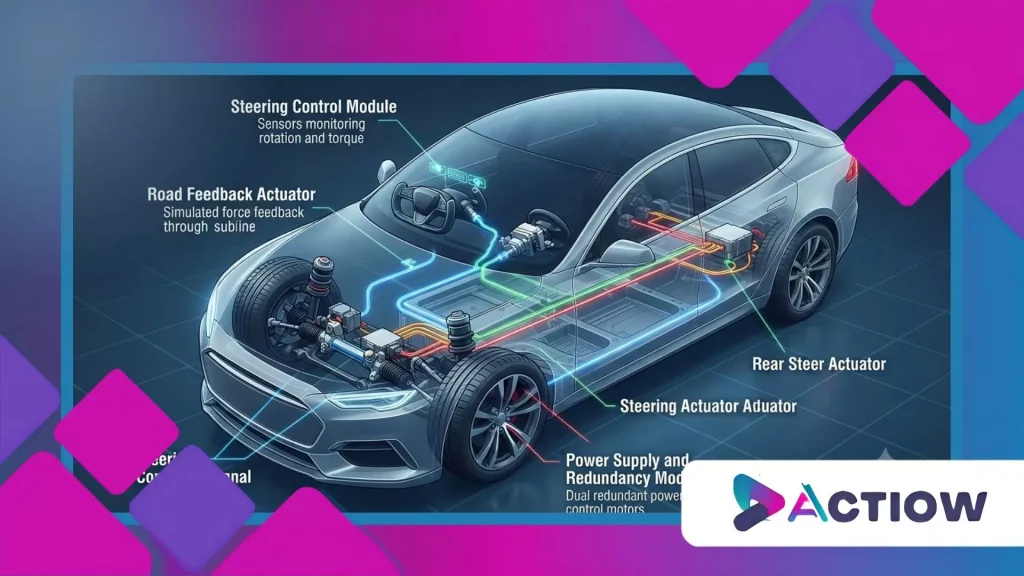
Technologie de direction électrique Il repose sur des unités de commande électroniques doubles sophistiquées, des circuits d'alimentation redondants et des servomoteurs à grande vitesse pour convertir les mouvements du volant en angles de roue.
Des capteurs mesurent instantanément la rotation du volant effectuée par le conducteur et envoient des paquets numériques cryptés aux actionneurs de la crémaillère de direction situés à quelques millimètres des roues avant.
Imaginez cette liaison électronique comme une impulsion nerveuse numérique parcourant une moelle épinière biologique sans connexion musculaire physique.
Lorsque les conducteurs tournent leur volant, des actionneurs de retour de force simulent la résistance de la route pour que le véhicule offre une sensation de conduite totalement naturelle.
Des recherches rigoureuses sur la sécurité automobile publiées par Société des ingénieurs automobiles indique que les redondances de direction électronique réduisent la latence à moins de cinq millisecondes lors des manœuvres d'évitement d'urgence.
Deux microprocesseurs surveillent en permanence l'état du système et activent instantanément les canaux d'alimentation de secours si la tension électrique principale chute de manière inattendue pendant le transport.
Cette architecture à sécurité intégrée de qualité aérospatiale garantit une fiabilité absolue dans des conditions météorologiques extrêmes et lors d'essais sur piste à grande vitesse.
Le calibrage logiciel remplace les lourds engrenages mécaniques, permettant aux constructeurs de mettre à jour le comportement de la direction des véhicules via des correctifs sans fil.
Comment les capteurs électroniques mesurent-ils l'entrée des roues ?
Des codeurs optiques et magnétiques suivent chaque fraction de degré lorsque le conducteur tourne le volant dans l'habitacle.
Ces capteurs haute résolution calculent la vitesse de rotation et les besoins en couple, traduisant instantanément le mouvement physique en coordonnées numériques précises.
Des algorithmes avancés filtrent les tremblements erratiques des mains du conducteur pour maintenir sans effort la stabilité en ligne droite sur autoroute.
++ Les meilleures applications pour apprendre à conduire
Pourquoi les circuits d'alimentation redondants sont-ils obligatoires ?
Le retrait de la colonne de direction mécanique signifie qu'une panne électrique pourrait entraîner une perte totale de contrôle directionnel sans systèmes de secours.
Les constructeurs installent des batteries secondaires isolées et des faisceaux de câbles parallèles afin de garantir le fonctionnement continu de la direction en cas de panne électrique totale. Cette conception redondante répond aux normes de sécurité automobile internationales les plus strictes.
Lire aussi : Comment les batteries à semi-conducteurs pourraient transformer les voitures électriques en 2026
Quel est le rôle des actionneurs de rétroaction ?
Des moteurs à résistance, montés directement derrière le volant, recréent des sensations de route authentiques en exerçant une pression sur les mains du conducteur.
Sans ces actionneurs de retour d'information, la direction serait totalement imprécise et déconnectée des conditions réelles d'adhérence des pneus. Les conducteurs se fient à cette résistance tactile pour évaluer en toute sécurité les limites d'adhérence en virage.
Quels sont les principaux avantages par rapport aux systèmes mécaniques ?
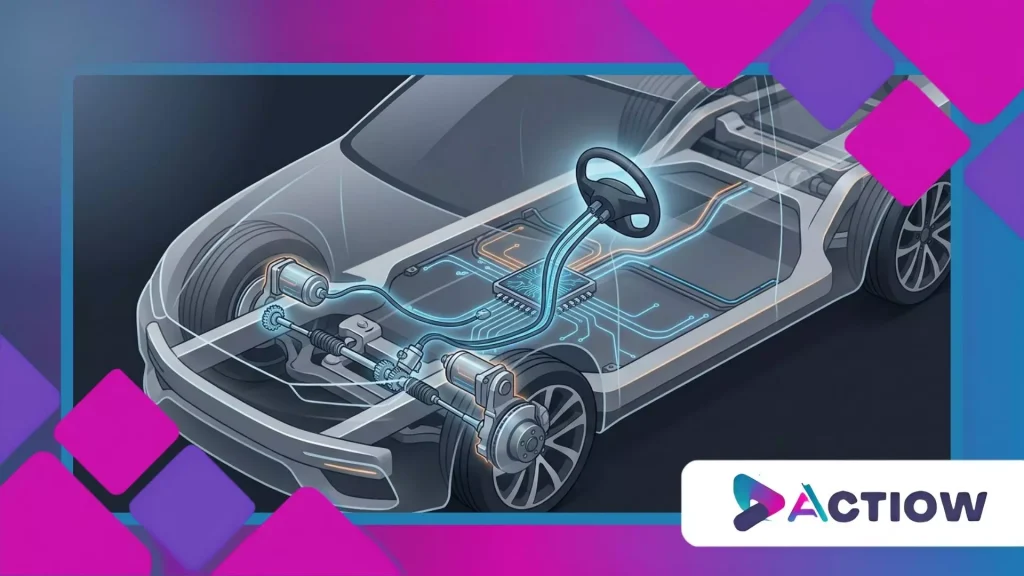
Technologie de direction électrique Elle offre une direction à rapport variable révolutionnaire, ajustant dynamiquement la sensibilité de la direction en fonction de la vitesse du véhicule et des conditions routières.
Le stationnement en créneau exige une rotation minimale du volant d'une butée à l'autre, tandis que la conduite sur autoroute requiert des virages plus larges pour éviter les changements de voie brusques.
Imaginez conduire une voiture de sport dont la géométrie de direction passe automatiquement et sans à-coups d'un chariot élévateur agile à une limousine de luxe.
Cette adaptabilité transforme les manœuvres de stationnement fastidieuses en tâches sans effort pour les usagers quotidiens.
La flexibilité de fabrication représente un autre avantage considérable, car les concepteurs automobiles peuvent facilement inverser le sens de la direction du volant pour les modèles destinés à l'exportation.
L'absence d'une lourde colonne de direction traversant le tablier avant permet aux ingénieurs en aménagement intérieur de gagner un espace précieux pour les jambes et d'améliorer les zones de sécurité en cas de collision.
D'après les rapports d'analyse du marché publiés par les principaux analystes du secteur automobile, plus de quinze pour cent des nouveaux véhicules électriques seront équipés de cette technologie. L'intégration de la direction assistée électronique assure une parfaite synergie entre efficacité, confort et sécurité.
En savoir plus: Comment les rétroviseurs numériques améliorent la visibilité dans la circulation
Comment le rapport de direction variable améliore-t-il l'agilité ?
À basse vitesse, un léger mouvement du volant suffit à obtenir un angle important des roues avant, facilitant ainsi les demi-tours et les manœuvres de stationnement dans les garages étroits.
Sur les autoroutes, une même rotation des roues induit des changements de direction subtils et stables, réduisant ainsi la fatigue du conducteur. Ce système intelligent de rapport de démultiplication redéfinit l'ergonomie du contrôle du véhicule.
Pourquoi l'emballage en cabine présente-t-il un avantage significatif ?
La suppression de la colonne de direction rigide libère un espace considérable sur le tableau de bord, permettant aux concepteurs d'introduire des volants escamotables innovants et des agencements à plancher plat.
Les concepts de véhicules autonomes exploitent cet espace vide au niveau des pieds pour rétracter complètement les commandes de direction lors de la conduite autonome sur autoroute. Le confort intérieur atteint des niveaux de luxe sans précédent.
Les profils de direction peuvent-ils être personnalisés pour les conducteurs ?
Le logiciel de direction numérique permet aux conducteurs de sélectionner leurs profils de conduite préférés, allant des modes confort ultra-légers aux réglages circuit agressifs, via les écrans d'infodivertissement.
Les familles partageant un même véhicule peuvent enregistrer leurs préférences personnalisées de fermeté de direction directement dans leurs profils utilisateurs numériques. La personnalisation devient ainsi une fonctionnalité logicielle essentielle.
Pourquoi les redondances de sécurité et la fiabilité sont-elles importantes ?
Technologie de direction électrique fait l'objet d'un examen public intense concernant les vulnérabilités en matière de cybersécurité et les pannes électriques potentielles lors de scénarios de transport à grande vitesse.
Les critiques s'interrogent fréquemment sur ce qui se passe si un véhicule subit une surtension catastrophique alors qu'il circule sur une autoroute métropolitaine très fréquentée à minuit.
Les ingénieurs répondent à ces préoccupations légitimes en matière de sécurité en intégrant des bus de données à triple redondance et des verrous d'embrayage mécaniques isolés qui s'enclenchent automatiquement.
Considérez ces barrières de sécurité comme les masques à oxygène d'urgence d'un avion, qui se déploient instantanément uniquement en cas d'anomalies extrêmes.
Des données d'essais complets provenant d'instituts de tests automobiles indépendants prouvent que les architectures de direction électronique modernes surpassent les liaisons mécaniques traditionnelles en termes de temps de réaction pour éviter les collisions.
Les actionneurs numériques exécutent des corrections de direction plus rapidement que les muscles humains ne peuvent réagir physiquement aux dangers soudains de la route.
Bien que le scepticisme du public demeure un obstacle mineur, des millions d'heures de fonctionnement de systèmes de commande électronique commerciaux démontrent une fiabilité opérationnelle irréprochable.
L'innovation exige toujours de surmonter la peur initiale grâce à une validation technique rigoureuse et transparente.
Comment les ingénieurs préviennent-ils les failles de cybersécurité ?
Les développeurs de logiciels automobiles utilisent des microprocesseurs cryptographiques sécurisés matériellement qui cryptent toutes les transmissions de données internes entre le volant et les actionneurs de la crémaillère de direction.
Les pare-feu isolent les commandes de pilotage des systèmes de divertissement, empêchant ainsi toute tentative de piratage externe malveillante. Les protocoles de sécurité sont conformes aux normes de chiffrement bancaires modernes.
Que se passe-t-il lors d'une panne électrique totale ?
Des mécanismes d'embrayage mécaniques intégrés verrouillent la crémaillère de direction dans une position fixe en ligne droite ou activent des canaux d'alimentation de secours pour guider le véhicule en toute sécurité.
Les conducteurs conservent une maîtrise directionnelle suffisante pour se garer sans incident sur les bandes d'arrêt d'urgence des autoroutes à forte circulation. Des dispositifs de sécurité intégrés garantissent l'absence de perte de contrôle catastrophique.
Comment les températures extrêmes affectent-elles les actionneurs ?
Les servomoteurs de direction subissent des tests rigoureux en chambre thermique, allant de moins quarante degrés Celsius à plus de cent degrés Celsius.
Des lubrifiants haute température spécifiques et des boîtiers électroniques étanches protègent les composants internes contre le gel, le sel de déneigement et la boue corrosive. Sa robustesse face aux intempéries est comparable à celle des arbres mécaniques traditionnels en acier.
Matrice comparative des technologies de direction automobile
Le tableau structuré ci-dessous compare les colonnes de direction mécaniques traditionnelles aux systèmes électroniques modernes de direction électrique.
| Paramètre technique | Colonnes de direction mécaniques | Systèmes de direction électriques modernes |
| Liaison physique | Arbre en acier rigide et joints universels | Signaux numériques purs et actionneurs électroniques |
| Rapport de direction | Rapport de transmission mécanique fixe | Rapport électronique variable en fonction de la vitesse du véhicule |
| Emballage cabine | Nécessite un espace de colonne intrusif à travers le pare-feu | Tableau de bord et agencement du plancher complètement ouverts |
| Poids et efficacité | Assemblage d'acier lourd augmentant la consommation de carburant | Câblage électrique léger permettant des économies d'énergie |
Adopter l'évolution numérique de la dynamique des véhicules
Maîtriser technologie de direction électrique représente un bond en avant monumental dans l'ingénierie automobile, alliant l'informatique à la précision mécanique pour des expériences de conduite supérieures.
En éliminant les colonnes physiques rigides, les fabricants bénéficient d'une liberté sans précédent en matière d'emballage intérieur, d'une dynamique de manutention variable et de vitesses de réponse de sécurité avancées.
L'avenir des transports personnels est entièrement numérique, extrêmement réactif et conçu avec une précision méticuleuse pour protéger les vies humaines.
Prenez un instant pour réfléchir à la manière dont les systèmes de contrôle informatisés continuent de remodeler vos trajets quotidiens.
Que pensez-vous du remplacement des colonnes de direction mécaniques par des systèmes de direction électroniques intelligents ? Partagez votre avis dans les commentaires ci-dessous !
Foire aux questions
Ma voiture pourra-t-elle encore tourner si la batterie principale tombe complètement en panne ?
Les systèmes de direction électriques modernes utilisent des condensateurs d'alimentation de secours dédiés et des batteries auxiliaires conçus pour maintenir la fonctionnalité de direction en cas de panne de l'alimentation électrique principale.
Ces réserves d'urgence fournissent une puissance suffisante pour guider votre véhicule en toute sécurité jusqu'au bord de la route.
La direction assistée électronique donne-t-elle une sensation de conduite totalement artificielle ?
Des moteurs de retour d'information sophistiqués simulent avec une telle précision la texture réaliste de la route, la résistance des pneus et le poids en virage que la plupart des conducteurs ne peuvent pas distinguer la direction électronique des systèmes hydrauliques traditionnels lors de leurs trajets quotidiens normaux.
Est-il possible d'installer des systèmes de direction électrique sur des véhicules plus anciens ?
L'installation d'une direction électronique sur les véhicules anciens est pratiquement impossible car elle nécessite une intégration poussée avec l'architecture électronique spécifique du véhicule, un câblage d'alimentation doublement redondant et des modules de contrôle de stabilité informatisés spécialisés.