
Honda Civic Hybrid vs Toyota Corolla Hybrid: Which Daily Driver Comes Out Ahead?
Anúncios
Honda Civic Hybrid vs Toyota Corolla Hybrid models represent the pinnacle of modern fuel-efficient engineering, dominating global sales charts while offering distinct daily driving experiences.
Modern automotive buyers demand extraordinary fuel economy without sacrificing driving dynamics, interior comfort, or advanced technological connectivity.
Choosing between these two legendary compact titans requires a careful examination of powertrain output, cabin ergonomics, and long-term ownership value.
Anúncios
This comprehensive review breaks down every critical detail to help you determine which electrified sedan truly deserves a spot in your garage.
Navigating this competitive automotive segment involves evaluating several core factors that impact daily commuting satisfaction.
- Analyzing raw powertrain performance, horsepower outputs, and immediate throttle response metrics.
- Comparing EPA fuel economy ratings, fuel tank sizes, and real-world cruising ranges.
- Evaluating rear-seat passenger legroom and overall cargo volume flexibility.
- Weighing starting retail prices against standard technology features and trim configurations.
What Are the Mechanical Differences Under the Hood?
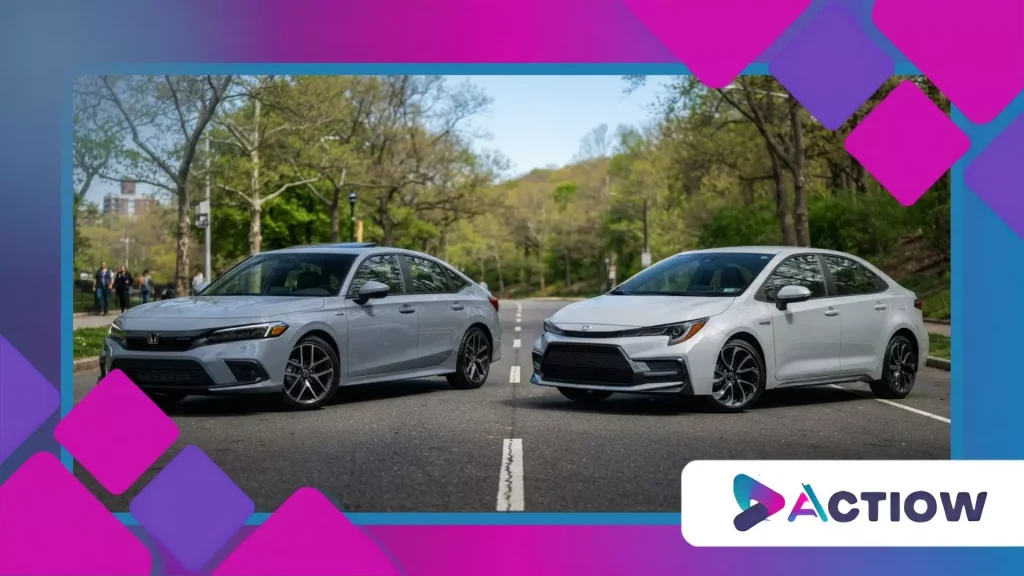
Honda Civic Hybrid vs Toyota Corolla Hybrid engineering philosophies diverge significantly when you examine their respective powertrain setups.
The Honda relies on a sophisticated dual-motor hybrid system paired with a 2.0-liter engine, generating a robust 200 horsepower.
Think of this system as an energetic athlete ready to sprint instantly at the green light without any sluggish hesitation.
Conversely, the Toyota employs a smaller 1.8-liter engine paired with an electronic continuously variable transmission, producing a modest 138 horsepower.
Automotive testing data published by major industry evaluators shows that the Honda accelerates from zero to sixty miles per hour in roughly 6.1 seconds.
Meanwhile, the Toyota takes over eight seconds to reach that same highway speed benchmark during independent track testing.
Drivers who value responsive merging power and spirited throttle delivery will immediately notice Honda’s distinct performance advantage on busy metropolitan freeways.
Power delivery fundamentally changes how each vehicle handles daily passing maneuvers.
How Does Torque Output Affect Real-World Driving?
Delivering 232 lb-ft of torque allows the Honda to pull away from stoplights with authoritative, electric-assisted punch.
The Toyota offers a more conservative 156 lb-ft of torque, which feels adequate for relaxed commuting but lacks mid-range punch. Higher torque ratings translate directly into effortless highway merging during heavy traffic congestion.
++ Jeep Compass EV vs Peugeot E-3008: which electric SUV travels farther?
Why Do Transmission Choices Matter for Daily Commuters?
Honda utilizes a linear response setup that mimics gear shifts, eliminating the annoying high-rev engine drone typical of traditional continuously variable transmissions.
Toyota relies heavily on its efficient eCVT, prioritizing maximum fuel conservation over engaging driver feedback. Transmission tuning dictates overall cabin refinement during aggressive acceleration.
Also read: Toyota Prius vs Honda Insight: The Most Efficient Hybrid for Daily Driving
Can All-Weather Capability Swing the Decision?
Toyota offers an electronic all-wheel-drive system on select sedan trims, providing superior traction during slippery winter snowstorms.
Honda configures its hybrid lineup exclusively with front-wheel drive, focusing purely on optimized weight distribution and agility. Regional climate conditions often make AWD a deal-breaker for northern buyers.
How Do Fuel Economy and Cruising Range Compare?
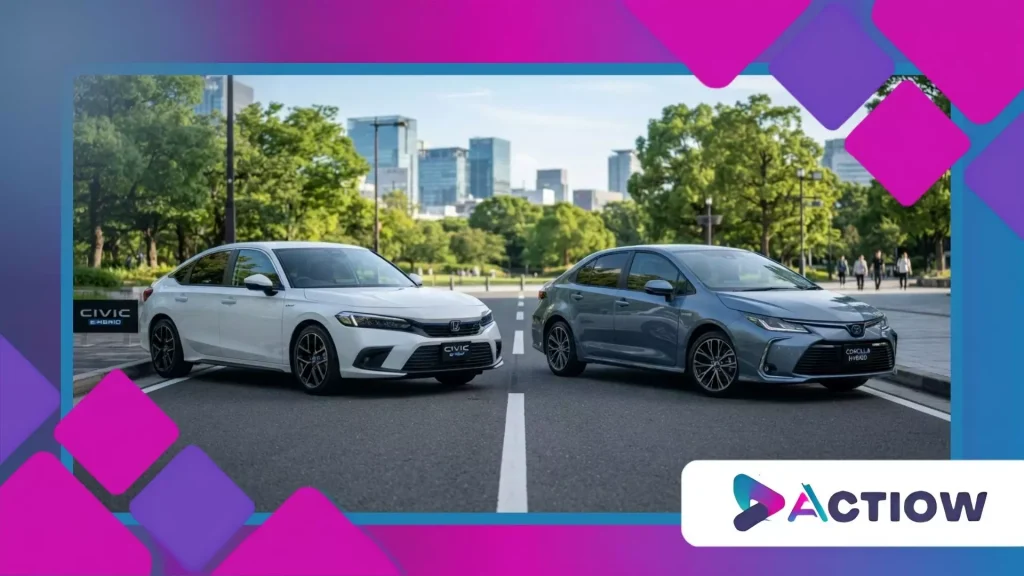
Honda Civic Hybrid vs Toyota Corolla Hybrid efficiency figures remain remarkably close, yet each vehicle achieves its remarkable mileage through distinct engineering paths.
Environmental Protection Agency estimates place the Toyota variant slightly ahead at roughly 50 miles per gallon combined in select trims.
The Honda closely follows, delivering an impressive 49 miles per gallon combined during mixed real-world testing conditions.
Think of these hyper-efficient powertrains as marathon runners sipping fuel sparingly across massive daily commutes.
Recent consumer fuel evaluations indicate that both sedans easily exceed 500 miles of total driving range on a single tank of gas. The Toyota benefits slightly from an 11.3-gallon fuel tank compared to the Honda’s 10.6-gallon reservoir.
Despite minor tank size differences, weekly fuel station visits become an afterthought in either machine. Long-distance road warriors will find exceptional financial relief behind the wheel of both options.
Read more: Tesla Model Y vs Kia EV6: Which Electric SUV Is Better in 2026?
How Do City and Highway Cycles Differ?
Stop-and-go urban traffic allows regenerative braking systems to recharge the hybrid battery packs efficiently in both vehicles.
Sustained high-speed highway cruising shifts the primary workload back to the internal combustion engines. Overall efficiency remains exceptionally high across all operational environments.
What Role Does Aerodynamic Design Play?
Sleek rooflines and active shutter grilles minimize wind resistance, helping both models slice through turbulent air effortlessly.
Reduced drag coefficients directly translate into improved high-speed fuel economy numbers on long interstate stretches. Aerodynamics act as an invisible shield against excessive fuel consumption.
Are Hybrid Batteries Covered by Long-Term Warranties?
Federal regulations mandate extensive hybrid component coverage, with both manufacturers offering robust eight-year or 100,000-mile battery warranties.
This institutional backing provides immense peace of mind for buyers transitioning into electrified vehicle ownership. Reliability concerns dissolve under comprehensive factory protection.
What Are the Interior Space and Technology Differences?
Honda Civic Hybrid vs Toyota Corolla Hybrid cabin dimensions reveal a clear winner when transporting adult passengers or bulky weekend cargo loads.
The Honda provides a generous 37.4 inches of rear legroom, comfortably accommodating taller adults during extended road trips.
The Toyota restricts rear passengers to 34.8 inches, creating a noticeably tighter fit for anyone sitting in the back. Think of the Honda interior as an airy modern loft apartment, while the Toyota feels more like a cozy compact cabin.
Cargo capacity further separates these two competitors, as the Honda is available in both sleek sedan and versatile hatchback body styles.
The Civic hatchback opens up to 24.5 cubic feet of cargo room, whereas the Toyota Corolla Hybrid is restricted strictly to a 13.1-cubic-foot trunk.
Infotainment layouts also differ, with Toyota offering slightly larger standard touchscreen displays on base trims. Practicality advocates will find the Honda’s packaging significantly more accommodating for active lifestyles.
How Do Infotainment Interfaces Compare?
Honda features a clean, driver-focused layout with physical climate knobs and a highly responsive touchscreen interface.
Toyota integrates modern software suites with wireless smartphone connectivity standard across almost all trim levels. User-friendly technology reduces driver distraction during busy daily commutes.
Why Is Rear Legroom Crucial for Growing Families?
Installing bulky rear-facing child safety seats requires ample longitudinal cabin space to prevent front passenger discomfort.
The Honda’s superior legroom ensures parents can travel comfortably without sliding their seats uncomfortably far forward. Family-friendly dimensions make daily errands much smoother.
How Do Cabin Materials Elevate the Driving Experience?
Soft-touch dashboard surfaces, matte metallic accents, and acoustic glass give the Honda a near-luxury ambiance that punches above its price class.
The Corolla utilizes durable, hard-wearing plastics that prioritize easy cleaning over tactile plushness. Interior refinement influences long-term ownership satisfaction deeply.
Technical Specifications and Performance Matrix
The structured table below compares core performance metrics, dimensions, and efficiency ratings between the two hybrid competitors.
| Vehicle Specification | 2026 Honda Civic Sport Hybrid | 2026 Toyota Corolla Hybrid SE |
| Net Horsepower Output | 200 horsepower | 138 horsepower |
| Total Torque Rating | 232 lb-ft of torque | 156 lb-ft of torque |
| 0–60 MPH Acceleration | Approximately 6.1 seconds | Approximately 8.5 seconds |
| Rear Seat Legroom | 37.4 inches | 34.8 inches |
| Maximum Cargo Space | Up to 24.5 cubic feet (Hatchback) | 13.1 cubic feet (Sedan) |
| EPA Fuel Economy (Combined) | 49 MPG | 50 MPG |
Selecting the Ideal Hybrid Sedan for Your Daily Commute
Honda Civic Hybrid engineering supremacy makes it the ultimate daily driver for enthusiasts who refuse to compromise on power, space, and refinement.
While the Toyota Corolla Hybrid wins on minor base pricing and available all-wheel-drive traction, the Honda delivers a superior overall ownership package.
Investing slightly more yields quicker acceleration, expansive hatchback utility, and a premium cabin environment that transforms mundane commutes into an absolute pleasure.
Evaluate your personal driving priorities and schedule a back-to-back test drive this weekend to experience the difference firsthand. Share your thoughts on these two efficient heavyweights in the comments below!
Frequently Asked Questions
Which hybrid sedan offers better resale value over time?
Both manufacturers maintain stellar historical reputation for long-term reliability, resulting in exceptionally strong residual values across pre-owned automotive markets.
Can the Honda Civic Hybrid run on regular unleaded gasoline?
Yes, both vehicles are engineered to operate efficiently on standard 87-octane regular unleaded gasoline without requiring expensive premium fuel.
Does the Toyota Corolla Hybrid require more frequent maintenance?
Routine service intervals are nearly identical for both models, focusing on standard hybrid system inspections, tire rotations, and synthetic oil changes.
Is the Honda Civic Hybrid available in a traditional sedan body style?
Yes, buyers can choose between a traditional four-door sedan and a versatile five-door hatchback configuration depending on their cargo needs.
Which model is better suited for tall drivers and passengers?
The Honda Civic Hybrid provides superior front and rear head-and-legroom dimensions, making it significantly more comfortable for taller occupants.