
Segnali che la batteria della tua auto sta per scaricarsi prima di lasciarti a piedi
Annunci
Signs your car battery is about to fail often appear weeks before a vehicle refuses to turn over in an empty parking lot.
Modern automobiles rely heavily on steady electrical currents to power everything from advanced driver-assistance sensors to basic fuel injection systems.
When a 12-volt battery loses its ability to hold a reliable charge, the entire electrical architecture begins to suffer subtle disruptions.
Annunci
Drivers frequently dismiss these early warnings as minor software glitches or temporary cold-weather sluggishness.
Recognizing these mechanical and electrical red flags early saves motorists from expensive roadside towing fees and dangerous highway breakdowns.
Industry data from the American Automobile Association reveals that automotive battery failure remains one of the top three causes of emergency roadside assistance calls across North America each year.
Paying close attention to how your vehicle starts, illuminates, and behaves under load provides the best defense against unexpected immobilization.
Key Takeaways Inside This Guide
- Auditory and Ignition Red Flags: How cranking speed, clicking noises, and starter hesitation reveal internal voltage drops.
- Electrical and Visual Warning Indicators: Identifying dimming cabin lights, dashboard battery icons, terminal corrosion, and swollen battery cases.
- Diagnostic Testing and Lifespan Benchmarks: Comparing healthy voltage readings against failing thresholds and determining when replacement beats jump-starting.
- Preventative Maintenance and Driver FAQs: Practical habits to extend battery longevity alongside direct answers to common roadside emergencies.
What Are the Early Mechanical and Electrical Warning Signs?

Why Does the Engine Crank Slowly When Turning the Key?
A sluggish engine crank represents the most recognizable physical symptom of an aging power cell.
When you turn the ignition key or press the start button, the starter motor demands a massive surge of cold cranking amps to spin the flywheel.
If the internal lead plates have degraded through sulfation, the battery struggles to deliver that immediate burst of energy.
You will hear the engine turn over noticeably slower than usual, producing a drawn-out, laboured whining sound before finally catching.
Ignoring this hesitation almost guarantees that the next cold morning will result in a dead starter circuit.
Think of a weakening car battery like a smartphone stuck at three percent charge while running demanding navigation apps in freezing weather.
The device still powers on, yet every function lags behind your touch until the screen abruptly goes black.
Similarly, a compromised automotive battery can barely sustain basic ignition demands while simultaneously powering fuel pumps and engine control modules.
For instance, a commuter in Chicago might notice their sedan taking three full seconds to fire up after sitting overnight in January, whereas it previously started instantaneously.
Addressing this slow crank immediately prevents the alternator from overworking itself to compensate for the dying cell.
How Do Dimming Lights and Flickering Electronics Signal Battery Trouble?
Electrical accessories act as real-time barometers for your vehicle’s charging health.
Because headlights, dashboard backlights, and infotainment screens require consistent voltage, any dip in battery capacity causes visible fluctuations.
You might observe your headlights brightening when you press the accelerator pedal and dimming when the engine drops to an idle at a stoplight.
Power windows rolling up more slowly than normal or windshield wipers dragging across dry glass also indicate insufficient amperage.
Modern vehicles equipped with start-stop technology often disable that fuel-saving feature automatically when the battery management system detects low state-of-charge levels.
Recognizing signs your car battery is about to fail through cabin electronics prevents sudden nighttime visibility loss.
Consider a driver heading home during a heavy rainstorm who turns on the defroster, heated seats, and high beams simultaneously.
If the battery lacks reserve capacity, the infotainment screen may reboot spontaneously while the interior dome lights flicker faintly.
These symptoms occur because the alternator cannot single-handedly supply peak electrical demand without healthy battery buffering.
Testing the electrical load at a certified service center clarifies whether the battery or the voltage regulator is causing the instability.
++ Perché il rumore dei cuscinetti delle ruote non dovrebbe mai essere ignorato dal conducentes
What Does a Clicking Sound Instead of Engine Ignition Mean?
Hearing a rapid series of sharp clicks when turning the key signals that the battery lacks enough amperage to engage the starter solenoid fully.
The electrical current is strong enough to push the starter pinion gear outward toward the flywheel, yet too weak to spin the heavy engine components.
Consequently, the solenoid snaps back and forth repeatedly, creating that distinct metallic machine-gun chatter under the hood.
In more advanced stages of depletion, you may hear only a single dull click followed by complete silence across the dashboard.
Drivers often mistake this clicking noise for a broken starter motor, leading to unnecessary and costly component replacements.
Before condemning the starter assembly, technicians always verify open-circuit battery voltage and inspect the terminal clamps for tight contact.
A loose or heavily oxidized ground cable can mimic a dead battery by restricting current flow during high-amperage ignition draws.
Wiggling the battery cables gently while wearing protective gloves sometimes restores temporary contact if corrosion is the sole culprit.
However, repeated clicking almost always confirms that internal cell degradation has reached a critical threshold.
How Can Visual Inspections and Dashboard Alerts Confirm Battery Degradation?
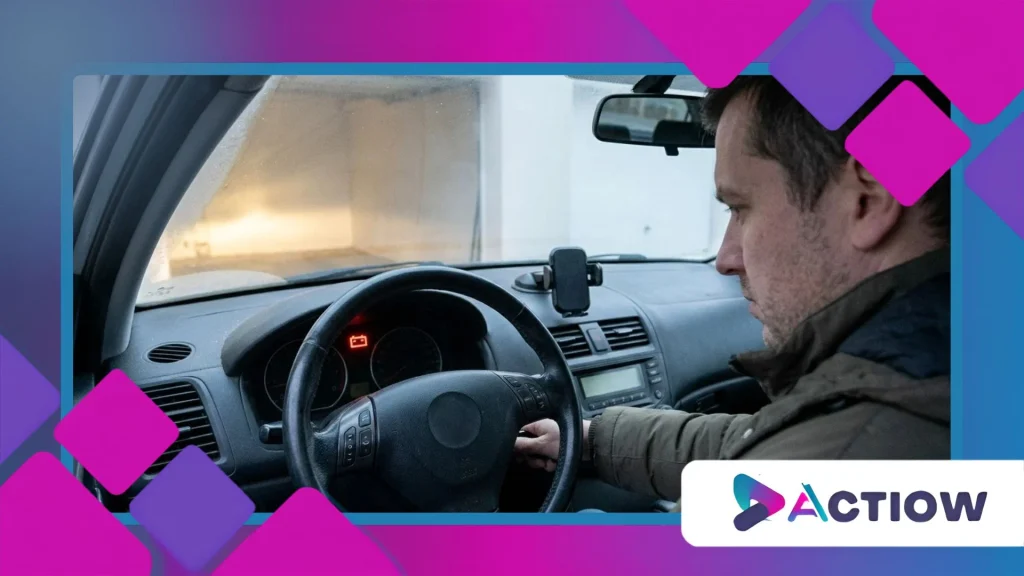
What Do Dashboard Warning Lights Actually Tell You?
Many motorists assume the red battery-shaped icon on the instrument cluster simply means the battery needs recharging.
In reality, that warning indicator illuminates when the vehicle’s onboard computer detects that charging system voltage has dropped below approximately 13.5 volts while the engine is running.
While a failing alternator or snapped serpentine belt frequently triggers this light, a battery with an internal short circuit can also drag down system voltage.
Modern vehicles may additionally display text warnings such as “Charging System Service Now” or “Low Battery Voltage” on the digital cluster.
Understanding these signs your car battery is about to fail empowers drivers to react before the vehicle stalls in traffic.
When the battery warning light appears mid-drive, the car is operating exclusively on stored battery reserve rather than alternator output.
Turning off non-essential accessories like the air conditioning, heated mirrors, and stereo maximizes remaining driving range toward the nearest repair facility.
Continuing to drive indefinitely with an active charging alert will inevitably drain the battery completely, disabling electronic power steering and fuel delivery.
Prompt diagnostic scanning isolates whether an internal battery fault or an external charging component triggered the alert.
Leggi anche: Come la rimozione delle contaminazioni della vernice protegge il valore di rivendita del veicolo.
How Does Terminal Corrosion Affect Electrical Performance?
Opening the hood to inspect the battery posts frequently reveals crusty, bluish-white or greenish powder accumulating around the metal clamps.
This buildup consists of copper sulfate and lead sulfate formed when hydrogen gas escapes through battery vents and reacts with moisture and metal terminals.
Corrosion acts as an electrical insulator, creating high resistance that blocks electricity from flowing freely between the battery and the starter cable.
Even a brand-new battery cannot crank an engine reliably if thick mineral deposits coat the contact surfaces.
Cleaning terminal buildup requires mixing baking soda with warm water and scrubbing the posts with a stiff wire brush after disconnecting the negative cable first.
Neglecting this simple maintenance task forces the charging system to push current through a bottleneck, generating excess heat that warps battery posts.
Furthermore, acidic residue can eat through copper wiring insulation, leading to expensive harness repairs down the road.
Applying a thin coat of dielectric grease or anti-corrosion spray after cleaning seals out moisture and preserves strong conductivity.
Per saperne di più: 10 segnali che indicano che la batteria della tua auto potrebbe guastarsi prima dell'arrivo dell'inverno
Why Is a Swollen Battery Case or Rotten Egg Smell Dangerous?
Physical deformation of the outer plastic casing signals severe internal distress that requires immediate replacement.
Extreme under-hood heat or an overcharging alternator causes liquid electrolyte inside the battery to boil and generate excessive internal gas pressure.
As pressure mounts, the flat sides of the battery case bulge outward like an overinflated pillow.
A swollen battery cannot be salvaged or safely recharged, as the internal lead plates have already warped and separated from their separators.
Alongside case swelling, a pungent odor resembling rotten eggs indicates leaking sulfuric acid gas.
Have you ever popped your hood after a long highway drive and caught a sharp, sulfur-like stench hanging in the air?
That unmistakable smell means the battery is venting toxic hydrogen sulfide gas due to internal overheating or a cracked casing.
Touching leaking battery acid causes severe chemical burns, while accumulated hydrogen gas poses a genuine explosion risk near sparks or hot exhaust manifolds.
Mechanics recommend wearing eye protection and acid-resistant gloves when removing any leaking or swollen battery for immediate recycling.
When Should You Test, Jump-Start, or Replace an Aging Battery?
How Long Does a Typical Automotive Battery Last?
Most conventional flooded lead-acid car batteries deliver reliable service for three to five years under normal driving conditions.
Climate extremes heavily influence this timeline, with scorching summer temperatures accelerating internal fluid evaporation and plate corrosion far faster than freezing winters.
While cold weather exposes weak batteries by thickening engine oil and slowing chemical reactions, extreme heat actually inflicts the underlying structural damage.
Drivers living in hot regions like Arizona or Texas frequently replace batteries closer to the three-year mark, whereas motorists in milder climates often reach five years.
Short-trip driving habits also shorten battery lifespan dramatically. Every engine start consumes substantial energy that requires roughly fifteen to twenty minutes of steady highway driving for the alternator to replenish fully.
Vehicles used exclusively for five-minute errands never reach full state-of-charge, allowing lead sulfate crystals to harden permanently on the internal plates.
Tracking the installation date stamped on the battery’s top sticker helps owners anticipate replacement before year four arrives.
What Voltage Readings Indicate a Healthy Versus Failing Battery?
Using an inexpensive digital multimeter provides objective proof of battery health without guesswork.
To perform an accurate static voltage test, turn off the engine and headlights, then wait at least one hour so surface charge dissipates.
Touch the red multimeter probe to the positive battery terminal and the black probe to the negative terminal to read the resting open-circuit voltage.
A fully charged, healthy 12-volt automotive battery will register between 12.6 and 12.8 volts.
Valutazione signs your car battery is about to fail becomes straightforward when comparing multimeter numbers against industry benchmarks.
Readings between 12.2 and 12.4 volts indicate a partially discharged battery hovering around fifty percent capacity, which requires recharging and load testing.
Any resting measurement at or below 12.0 volts signifies a deeply discharged or internally damaged battery that struggles to crank an engine reliably.
Additionally, watching the multimeter while someone cranks the engine reveals cranking voltage; if the reading plunges below 9.6 volts during ignition, the battery needs immediate replacement.
How Can You Tell If You Need a Jump-Start or a Full Replacement?
Needing an occasional jump-start after accidentally leaving interior map lights on overnight does not automatically condemn a healthy battery.
Once jump-started, driving the vehicle continuously for thirty minutes allows the alternator to restore normal operating voltage.
However, needing two or more jump-starts within a single month serves as a definitive warning that the battery can no longer retain a charge.
Repeatedly deep-cycling a standard starting battery permanently destroys its internal plate structure, making subsequent failures inevitable.
| Indicatore diagnostico | Healthy Battery Status | Early Warning Stage | Critical Failure Stage |
| Resting Voltage (Engine Off) | 12.6V – 12.8V | 12.2V – 12.4V | Below 12.0V |
| Cranking Voltage (During Start) | Above 10.0V | 9.6V – 10.0V | Below 9.6V |
| Engine Start Behavior | Instantaneous, brisk crank | 2–3 second sluggish crank | Rapid clicking or total silence |
| Headlight Intensity at Idle | Steady, bright illumination | Slight dimming until revved | Noticeably dim or flickering |
| Physical Case & Terminals | Flat sides, clean metal posts | Minor white powder buildup | Swollen sides, leaking acid, sulfur odor |
| Recommended Driver Action | Routine semi-annual check | Clean terminals & load test | Immediate battery replacement |
Protecting Your Vehicle Against Unexpected Roadside Breakdowns
Proactive awareness remains the smartest strategy for avoiding the frustration and safety hazards of a dead vehicle.
By recognizing subtle auditory cues like slow engine cranking, monitoring dashboard voltage alerts, and performing quick visual checks for terminal corrosion or case swelling, drivers gain crucial lead time before total electrical collapse occurs.
Recognizing signs your car battery is about to fail allows you to schedule an affordable replacement on your own terms rather than waiting hours for an emergency tow truck in inclement weather.
Pair annual voltage load testing with clean battery terminals and periodic highway drives to maximize every year of service life.
Check your battery’s manufacturing date stamp today, and share your own roadside battery experiences or maintenance tips in the comments below to help fellow drivers stay safely on the road.
Domande frequenti
Can a failing car battery cause my car to stall while driving?
Yes, although the alternator powers most electrical systems once the engine is running, a severely failing or internally shorted battery can disrupt voltage regulation.
In modern vehicles with sensitive engine control computers and electronic fuel injection, sudden voltage drops can cause erratic shifting, dashboard resets, or complete engine stalling at low speeds.
How long should I drive my car after a jump-start to recharge the battery?
You should drive your vehicle continuously at highway speeds for at least 20 to 30 minutes after a jump-start to allow the alternator to restore sufficient charge.
Idling in the driveway generates far lower alternator amperage and will rarely replenish a deeply depleted battery enough for the next cold start.
Does cold weather kill car batteries or just reveal existing damage?
Cold weather exposes preexisting battery weaknesses rather than causing the underlying damage itself.
High summer heat evaporates internal electrolyte fluid and corrodes lead plates, while freezing winter temperatures thicken engine oil and slow chemical reactions inside the already weakened battery, preventing it from delivering necessary cold cranking amps.
Is it safe to jump-start a car battery that looks swollen or cracked?
No, attempting to jump-start a swollen, cracked, or leaking car battery is extremely dangerous and can cause the casing to rupture or explode.
Swelling indicates trapped internal gases and severe overheating, so you should leave the vehicle off and arrange for safe battery replacement and hazardous waste recycling.
How much does it typically cost to replace a standard car battery?
Replacing a standard flooded lead-acid car battery typically costs between $120 and $250 including installation, depending on your vehicle’s group size and cold cranking amp requirements.
Vehicles equipped with start-stop systems or luxury electronics require Absorbed Glass Mat (AGM) batteries, which generally range from $220 to $380 installed.
