
The Latest Advances in Autonomous Parking Systems
Annunci
Autonomous parking systems represent the most significant leap forward in personal transportation safety, driver convenience, and urban space optimization since the introduction of automatic transmission.
As urban density increases worldwide, finding and maneuvering into tight parking spaces consumes time, burns excess fuel, and causes millions of minor vehicle collisions annually.
Modern vehicular architecture leverages advanced sensor fusion, edge computing, ultra-wideband localization, and deep neural networks to transform parking from a stressful daily chore into an entirely automated experience.
Annunci
Today, automotive engineering extends beyond simple steering assistance to deliver fully uncrewed driverless valet capabilities in complex multi-level garages.
This technological evolution redefines how drivers interact with personal vehicles, mobility hubs, and smart city infrastructure.
Modern automotive software seamlessly integrates camera feeds, millimeter-wave radar, and ultrasonic rangefinders to build real-time dynamic environmental maps.
Vehicles can now detect non-standard obstacles, negotiate narrow garage aisles, avoid pedestrians, and locate empty stalls without human oversight.
As regulatory frameworks adapt and smart infrastructure expands, driverless maneuvering transitions from a luxury convenience feature into a fundamental pillar of future intelligent transportation networks.
What You Will Discover in This Guide
- What Are Modern Autonomous Parking Systems and How Have They Evolved?
- How do sensor fusion, computer vision, and machine learning power driverless maneuvering?
- What key differences separate legacy park assist technologies from modern infrastructure-backed Automated Valet Parking?
- Why is real-time high-definition mapping critical for navigating dense indoor parking facilities?
- Why Are Auto-Parking Technologies Transforming Urban Mobility and Smart Cities?
- How do self-parking solutions reduce traffic congestion and carbon emissions in city centers?
- What safety improvements drastically lower low-speed parking lot collisions and insurance risks?
- How can commercial parking facilities optimize floor space and increase vehicle capacity?
- How Do Driverless Valet Platforms Function and What Lies Ahead for Mobility?
- How does local vehicle intelligence communicate with connected parking infrastructure?
- What technical, legal, and cyber-security challenges must manufacturers solve for global adoption?
- What key metrics differentiate modern automated parking levels across the industry?
What Are Modern Autonomous Parking Systems and How Have They Evolved?
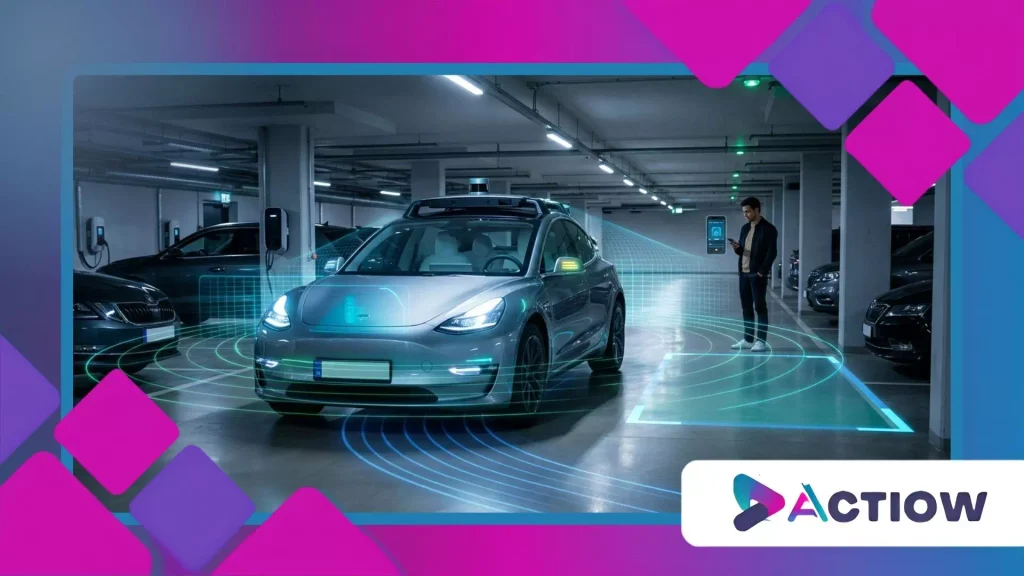
How Do Sensor Fusion and Edge Computing Drive Self-Parking Solutions?
Moderno autonomous parking systems rely on complex multi-sensor arrays that combine ultrasonic sensors, wide-angle cameras, and short-range radar modules.
High-performance domain controllers process these incoming data streams locally within milliseconds to build precise three-dimensional surround vectors.
Deep neural networks analyze these spatial models to identify pavement markings, concrete pillars, curb heights, shopping carts, and moving pedestrians around the vehicle perimeter.
This edge computing pipeline allows the vehicle to calculate smooth steering angles, throttle inputs, and braking pressure with sub-inch accuracy.
When navigating tight spaces, visual camera feeds continuously calibrate against ultrasonic distance markers to verify environmental clearances.
The integration of solid-state LiDAR and spatial sonar prevents blind spot blinders, ensuring total situational awareness in subterranean garages.
Advanced control algorithms handle multi-point parallel turns and reverse perpendicular backing maneuvers smoothly without driver intervention.
These localized computation models maintain flawless operational safety even when cellular connectivity or satellite signals drop in underground structures.
What Distinguishes Traditional Park Assist from Automated Valet Parking?
Legacy parking assistance software functioned primarily as an actuator guide, controlling steering inputs while requiring human operators to operate pedals, shift gears, and maintain visual vigilance.
Contemporary driverless platforms eliminate human supervision entirely, enabling true drop-off-and-walk-away capability at designated garage entrances.
Advanced architectures interact directly with facility infrastructure through dedicated short-range communications and wireless local networks.
This transition shifts operational liability from individual human drivers directly to automated system software, fundamentally changing automotive manufacturing standards and insurance models.
The functional gap between driver-assist mechanisms and driverless parking reflects a major jump in processing autonomy.
Modern systems continuously execute contingency pathways, applying emergency braking whenever unexpected obstacles cross the vehicle’s trajectory.
Vehicles now feature redundant steering motors, secondary electronic braking systems, and isolated power supplies to handle single-point hardware faults safely.
This operational resilience allows cars to maneuver safely through crowded public structures without human supervision.
++ Le migliori app per imparare a guidare
Why Is High-Definition Mapping Essential for Subterranean Maneuvers?
Global positioning systems regularly lose signal precision when vehicles enter underground facilities or multi-story reinforced concrete parking structures.
Moderno autonomous parking systems overcome signal loss by utilizing pre-mapped spatial footprints and Simultaneous Localization and Mapping (SLAM) algorithms.
Optical sensors track structural landmarks, structural columns, and lane markers, comparing real-time telemetry against stored spatial templates.
This precise local positioning strategy enables accurate vehicle guidance down to fractions of an inch, even deep underground.
Vehicle-to-Infrastructure (V2I) communication modules constantly sync with central garage management servers to receive real-time updates on available spaces.
Smart facility nodes track moving pedestrian traffic, oncoming vehicles, and temporary road barriers, broadcasting localized hazard maps directly to approaching cars.
This collaborative architecture reduces onboard sensor processing loads while drastically improving maneuvering safety across low-visibility garage aisles.
By combining localized edge processing with smart facility communications, self-parking platforms easily manage complex structural layouts.
Why Are Auto-Parking Technologies Transforming Urban Mobility and Smart Cities?
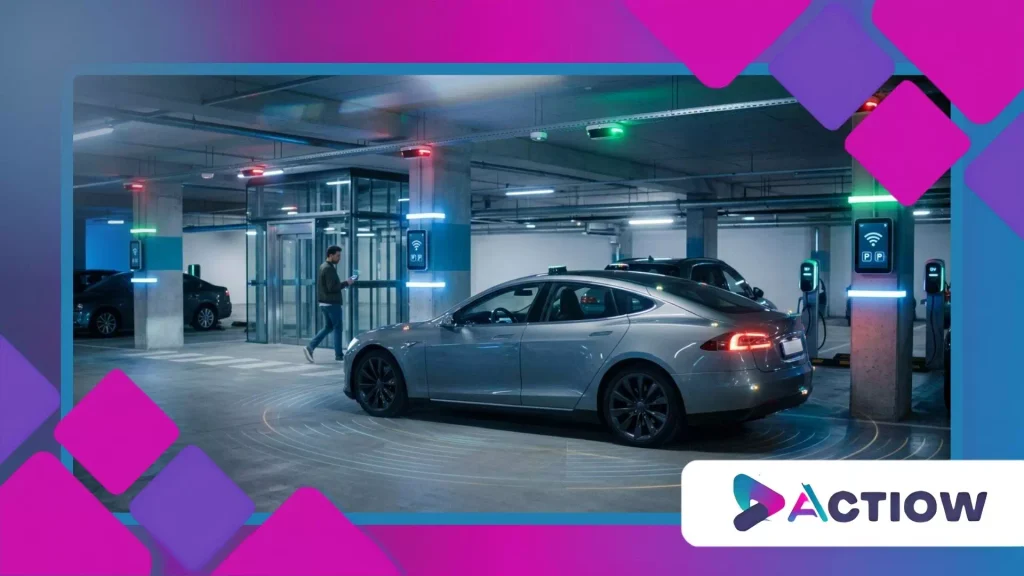
How Do Automated Maneuvering Systems Reduce Urban Congestion and Emissions?
Cruising for open parking spaces accounts for roughly 30% of total inner-city traffic congestion during peak business hours.
Intelligent automated parking networks streamline this search process by directing vehicles directly to assigned, available parking spots without circuitous cruising.
Reducing search times lowers fuel consumption and eliminates localized tailpipe emissions in crowded commercial districts.
According to research published by the Transportation Research Board, optimized automated parking algorithms reduce indoor cruising time by up to 80%, substantially cutting localized greenhouse gas emissions in commercial centers.
Imagine a busy downtown street during evening rush hour, where instead of drivers circling blocks endlessly looking for spots, vehicles head straight into automated drops.
This direct routing smooths municipal traffic flows and eliminates sudden double-parking disruptions along major thoroughfares.
Reduced urban idling protects local air quality, lowers urban noise pollution, and improves overall urban livability.
Furthermore, automated parking algorithms eliminate erratic acceleration and unnecessary idling, conserving precious kilowatt-hours in electric vehicles.
Leggi anche: Come le batterie a stato solido potrebbero rivoluzionare le auto elettriche nel 2026
What Safety Benefits Eliminate Low-Speed Vehicle Collisions?
Low-speed parking maneuvers cause approximately 20% of reported consumer vehicle accidents and minor property damage claims every year.
Human errors, including blind spot lapses, pedal misapplication, and distraction, drive these frequent, expensive property claims.
Automated systems use 360-degree sensor arrays that monitor spatial clearances constantly, eliminating human reaction delays and blind spots.
Automatic emergency braking instantly stops the vehicle if a pedestrian, child, or another vehicle crosses its path.
These active safety protocols operate flawlessly regardless of poor garage lighting, adverse weather conditions, or tight structural pillars.
Eliminating minor garage collisions reduces vehicle repair costs and lowers insurance claims for fleet operators and personal car owners alike.
In addition, driverless drop-off services enhance personal security by allowing motorists to leave or retrieve vehicles in well-lit, monitored entry zones rather than navigating dark, multi-level garages alone late at night.
Per saperne di più: Come gli specchietti retrovisori digitali migliorano la visibilità nel traffico
How Do Smart Garages Maximize Commercial Real Estate Capacity?
Automated parking structures do not require human space to open vehicle doors inside parking stalls, allowing cars to park much closer together.
Eliminating door-opening clearances and structural pedestrian walkways increases garage spatial efficiency by 30% to 50% within existing footprints.
Commercial property developers can convert this saved garage volume into additional commercial space, residential units, or green urban parks.
High-density automated storage reduces structural construction costs while expanding real estate utility in expensive metropolitan areas.
High-density parking configurations also streamline urban EV charging infrastructure installation.
Automated systems can park electric vehicles sequentially over wireless induction charging pads, maximizing grid utilization without manual plug management.
Automated facility management platforms schedule, park, and charge vehicles efficiently based on predicted departure times.
This integrated approach converts static garage structures into active, efficient urban mobility hubs.
How Do Driverless Valet Platforms Function and What Lies Ahead for Mobility?
How Do Vehicle-to-Infrastructure Protocols Coordinate Automated Valet Parking?
Automated Valet Parking (AVP) combines local onboard compute power with cloud-connected facility control networks.
Upon arriving at a smart garage drop-off zone, the driver exits the vehicle and initiates the parking sequence via a smartphone app.
The facility platform conducts a security check, establishes a encrypted V2I connection, and transmits an optimized route map directly to the car.
The vehicle then maneuvers along the assigned path, continually exchanging speed and position data with facility cameras and sensor arrays.
This dual-layer architecture ensures continuous system redundancy throughout the automated parking operation.
If onboard sensors encounter localized visual obstructions, infrastructure cameras provide secondary situational data to guide the vehicle safely.
After receiving an app retrieval request, the central controller routes the car back to the pickup terminal, perfectly timed for the user’s arrival.
This smooth handshake between vehicle hardware and facility software ensures dependable automated performance.
What Legal, Regulatory, and Cyber-Security Obstacles Remain?
Widespread adoption of fully driverless autonomous parking systems requires clear international regulatory frameworks and standardized safety certifications.
Municipal authorities must establish unified legal liability models that explicitly outline responsibility between automakers, software developers, and garage operators in the event of an incident.
In response, global standards organizations are finalizing unified testing protocols to ensure safe cross-brand interoperability.
Clear legal standards give commercial operators the operational clarity needed to deploy driverless parking platforms broadly.
Robust cybersecurity protections are equally critical, as hyper-connected vehicles face risks of wireless interception and malicious interference.
Engineering teams implement multi-tiered encryption, hardware-based security modules, and strict authentication controls to defend V2I data channels against unauthorized access.
Regular over-the-air security patches and real-time network monitoring protect connected parking ecosystems against emerging cyber threats.
Resolving these legal and cybersecurity challenges builds long-term public trust in automated transportation technologies.
Key Metrics Defining Modern Autonomous Parking Architecture
The following table highlights the core parameters, operational metrics, and technological requirements across current driverless parking deployment standards:
| Functional Parameter | Assisted Parking (SAE Level 2) | Connected Valet Parking (SAE Level 4) | Next-Gen Smart Garage (SAE Level 4+) |
| Driver Location | Inside vehicle maintaining oversight | Exits vehicle at drop-off zone | Exits vehicle anywhere in zone |
| Primary Navigation | Onboard cameras & sonar sensors | Onboard SLAM + local V2I radio | Infrastructure-guided sensor fusion |
| Spatial Efficiency Gain | Baseline vehicle spacing (0%) | +25% denser stall allocation | +50% high-density optimized storage |
| Infrastructure Dependency | None (Fully autonomous vehicle) | Moderate (Local radio markers) | High (Active camera & sensor grid) |
| Pedestrian Hazard Protocol | Frenata automatica di emergenza | Geofenced perimeter isolation | Dynamic multi-nodal predictive stop |
Engineering Precision in Automated Mobility
Avanzato autonomous parking systems bridge the gap between driver-assist feature packages and fully autonomous urban transport networks.
Integrating high-precision spatial sensors, edge computing networks, and smart infrastructure hubs converts dense parking garages into highly efficient, safer mobility centers.
Eliminating minor collisions, cutting urban traffic congestion, and maximizing urban land use deliver clear economic and environmental benefits to modern cities.
As global safety frameworks align and connected infrastructure expands, driverless maneuvering will continue redefining how vehicles interact with urban environments.
How do you view the transition toward fully driverless parking systems in your daily commute, and would you trust your vehicle to park itself in a multi-story garage? Share your thoughts and experiences in the comments below!
Domande frequenti
What happens if an autonomous parking system encounters an unexpected obstacle underground?
If an onboard camera or radar detects an unmapped obstacle, such as a dropped box or a wandering pet, the vehicle instantly stops via its automated emergency braking system.
The car’s onboard computer then recalculates an alternate route around the obstruction using local SLAM software.
If the path remains completely blocked, the vehicle notifies the garage’s central control system via V2I communications, requesting remote human supervision or garage attendant intervention.
Can legacy parking garages support automated valet parking technology?
Legacy parking facilities can support automated driverless operations by installing retrofitted Vehicle-to-Infrastructure hardware, including spatial optical sensors, localized wireless beacons, and high-precision mapping software.
Alternatively, highly capable autonomous vehicles equipped with advanced spatial SLAM algorithms can navigate traditional, non-connected structures independently using only their onboard sensor suite.
However, active smart garage infrastructure provides maximum space savings, higher operational density, and multi-vehicle coordination.
How do driverless parking systems perform in heavy rain, snow, or dark underground environments?
Underground garages and dark conditions pose little challenge to automated maneuvering platforms, as ultrasonic rangefinders, millimeter-wave radar, and near-infrared optical sensors operate effectively without external ambient light.
In severe outdoor weather like heavy snow or torrential rain, radar and ultrasonic waves penetrate poor atmospheric conditions to track physical spatial boundaries reliably.
Furthermore, pre-mapped structural footprints allow vehicles to maintain precise lane positioning even when pavement markings are obscured by snow or dirt.
Who bears legal liability if a fully automated vehicle causes property damage while parking?
When an Automated Valet Parking system operates at SAE Level 4, legal liability for vehicle operation shifts from the human driver to the automated system provider, vehicle manufacturer, or facility operator, depending on the fault domain.
If a mechanical failure or software error causes an incident, the automaker’s product liability insurance covers the resulting damages.
If a faulty infrastructure sensor sends incorrect positional guidance, liability falls on the commercial garage operator.
Are driverless self-parking systems susceptible to wireless hacking or remote hijacking?
Automated vehicle communications utilize end-to-end multi-layer military-grade encryption and secure hardware security modules to prevent unauthorized wireless access.
Vehicle-to-Infrastructure communication channels operate within isolated, authenticated frequency bands designed exclusively for intelligent transportation networks.
Continuous real-time anomaly detection software immediately isolates any vehicle exhibiting abnormal command signals, safely bringing the car to a controlled stop to prevent security breaches.
