
Nissan NX8: what this China-only SUV says about global EV demand
広告
の Nissan NX8 is officially transforming how legacy automakers fight back against local market stagnation by serving as a localized blueprint for shifting global electric vehicle preferences.
While Western brands struggle with high costs and production scaling issues, this sophisticated mid-to-large SUV demonstrates exactly how a traditional giant can adapt by utilizing specialized regional engineering.
To bridge the gap between traditional automotive prestige and rapid digital advancement, this vehicle integrates top-tier localized supply chains to target modern tech-focused families.
広告
Is the strategy of launching highly advanced, region-exclusive models the ultimate answer to surviving the brutal new energy vehicle transition?
Navigation Highlights
- Market Overview and Origins
- Architecture and Performance Features
- Global Strategic Implications
- Technical Performance Matrix
- よくある質問
What is the Nissan NX8?
Market Evolution
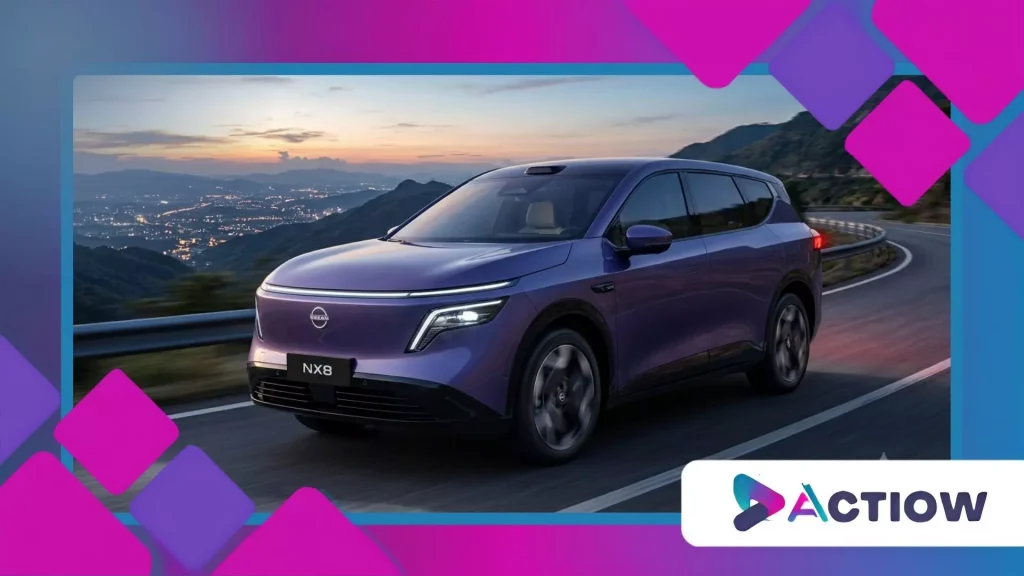
の Nissan NX8 represents the pinnacle of the automaker’s newly established N Series, designed in deep collaboration with Dongfeng to recapture momentum in the hyper-competitive Chinese market.
Launched in April 2026, this model functions like a specialized tailored suit, crafted specifically to fit the distinct, hyper-connected aesthetic demands of the world’s largest automotive arena.
Instead of forcing a single westernized layout onto diverse global buyers, Nissan chose to isolate this platform to master localized tech demands before initiating broad international exports.
This strategic shift highlights how legacy brands must abandon slow, centralized development cycles to keep up with agile domestic competitors that build cars at internet speed.
Design Philosphy
The visual language of the Nissan NX8 focuses heavily on minimalist, futuristic proportions, discarding outdated chrome grilles for a sweeping 2.4-meter full-width LED starlight strip.
This front light bar incorporates 138 synchronized LED units that frame an illuminated digital logo, providing a striking, ultra-modern presence during nocturnal urban commuting.
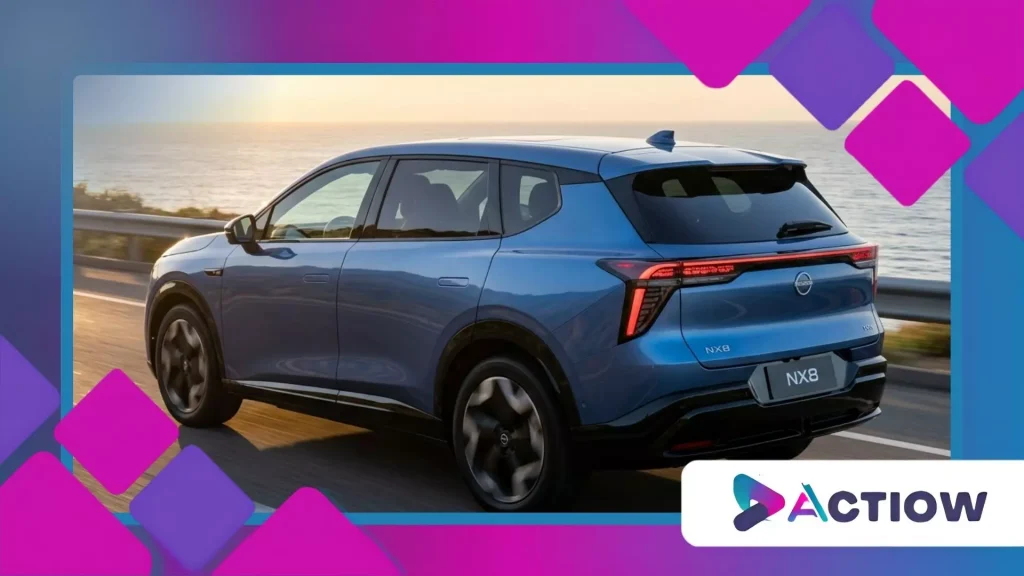
At the rear, an intricate quantum light curtain panel houses 2,064 customizable OLED modules, allowing owners to select personalized animated lighting patterns via a smartphone application.
The side profile combines flush retractable door handles with a sleek, low-drag coupe roofline, optimizing aerodynamic efficiency without reducing standard interior passenger volume.
++ ジープ・コンパスEVとプジョーE-3008:どちらの電気SUVがより遠くまで走れるのか?
Interior Innovations
Step inside the cabin, and the vehicle operates less like a traditional car and more like a high-end, mobile executive lounge.
The dashboard features dual 15.6-inch ultra-high-definition touchscreens powered by a cutting-edge Qualcomm Snapdragon 8295P processor, enabling zero-latency infotainment operations and seamless split-screen multi-tasking.
Passengers enjoy the premium comfort of AI Zero Gravity Seats 2.0, which utilize 25 adaptive air cushions to actively mitigate fatigue during long road trips.
Additionally, an expansive 63-inch augmented reality head-up display projects real-time navigation routes directly onto the asphalt ahead, ensuring drivers never need to take their eyes off the road.
How does the NX8 architecture work?
Powertrain Flexibility
The versatile engineering framework supporting the Nissan NX8 bypasses traditional single-powertrain limits by offering both Range-Extended Electric Vehicle (REEV) and Battery Electric Vehicle (BEV) setups.
The REEV variant employs a highly efficient 1.5-liter turbocharged inline-four engine acting purely as an onboard generator to feed a 261-horsepower rear electric drive motor.
This smart combination allows long-distance travelers to bypass public charging stations entirely, yielding an exceptional combined cruising range of up to 1,450 kilometers under standard test conditions.
For pure electric driving enthusiasts, the BEV models deliver up to 335 horsepower directly to the rear axle, ensuring swift, silent acceleration across all speeds.
こちらもご覧ください: トヨタ・プリウス vs ホンダ・インサイト:日常運転に最適なハイブリッド車はどちら?
Thermal Resilience
The advanced high-voltage setup includes a specialized Cloud Shield Battery 2.0 system, developed in partnership with CATL to survive extreme environmental changes.
This structural lithium iron phosphate package successfully underwent 146 rigorous internal safety assessments, proving its ability to operate reliably in temperatures ranging from -30 °C up to 60 °C.
To illustrate this stability, imagine a smartphone battery that maintains peak charging performance in both an Arctic blizzard and a scorching desert wasteland.
By resolving extreme temperature degradation issues, Nissan effectively removes one of the largest engineering hurdles currently facing mass-market electric vehicle adoption.
続きを読む: テスラ モデルY vs キア EV6:2026年に最も優れた電気SUVはどちら?
Charging Dynamics
The all-electric variants run on a modern 800V electrical architecture, supporting ultra-fast 5C charging speeds at compatible high-output public stations.
This advanced capability allows the battery pack to recover approximately 300 kilometers of driving range in just six minutes, matching the time it takes to buy a quick cup of coffee.
By drastically reducing downtime during highway travel, this rapid energy replenishment system eliminates long charging lines and lowers everyday range anxiety.
This fast-charging setup positions the vehicle well ahead of older, low-voltage charging platforms that dominate many current Western automotive markets.
Why does this China-only strategy matter?
Global Demand Realities
The intentional regional launch of the Nissan NX8 proves that the global electric vehicle transition is moving at completely different speeds across different geographic zones.
While Western regions face slower adoption due to limited infrastructure and high pricing, the Chinese market demands highly integrated digital platforms at accessible price points.
This model addresses these market shifts by launching with a highly competitive starting price of approximately 159,900 yuan, or roughly $23,400 USD.
This aggressive pricing demonstrates how deep integration with local supply networks allows legacy automakers to build high-tech vehicles without premium price tags.
Autonomous Capabilities
Equipped with an advanced driving suite co-developed alongside software specialist Momenta, the vehicle delivers advanced autonomous capabilities tailored for complex urban roads.
A roof-mounted LiDAR sensor works with high-definition cameras to build a real-time, 360-degree digital map of the surrounding driving environment.
The onboard system easily handles complex highway merging, adjusts speeds around unexpected construction zones, and navigates tight parallel parking spots without requiring driver input.
This level of automated safety shows how traditional car companies are evolving into software-driven mobility providers to remain competitive.
Future Export Corridors
Although optimized for domestic buyers, Nissan recently confirmed that this model will serve as a foundational export product for selected global expansion corridors.
Initial shipping plans focus on growing new energy vehicle segments across Latin America, the ASEAN region, and key Middle Eastern automotive hubs.
By utilizing these highly efficient production facilities as global export centers, the automaker aims to hit one million annual unit sales in China by 2030.
This strategy proves that region-specific vehicles are no longer isolated experiments, but are now core products shaping international vehicle portfolios.
Performance and Specifications
The following table provides a breakdown of the core technical differences across the primary trim levels available for this mid-to-large SUV:
| Specification Metric | 150 Pro (REEV) | 310 Max (REEV) | 580 Pro (BEV) | 650 Max (BEV) |
| Powertrain Type | Range Extender | Range Extender | Pure Electric | Pure Electric |
| バッテリー容量 | 20.3 kWh LFP | 37.4 kWh LFP | 73.0 kWh LFP | 81.0 kWh LFP |
| 電気レンジ | 102 km (CLTC) | 185 km (CLTC) | 580 km (CLTC) | 650 km (CLTC) |
| Total Combined Range | 1,200 km | 1,450 km | 580 km | 650 km |
| Drive Axle Power | 265 hp (Rear) | 265 hp (Rear) | 292 hp (Rear) | 335 hp (Rear) |
| Architecture Voltage | Standard 400V | Standard 400V | Advanced 800V | Advanced 800V |
| Infotainment Chip | Snapdragon 8295P | Snapdragon 8295P | Snapdragon 8295P | Snapdragon 8295P |
Shifting Paradigms
の Nissan NX8 proves that the survival of legacy automakers depends on their ability to integrate into advanced local technology supply chains.
By combining regional software partnerships with competitive manufacturing costs, this SUV highlights the growing division between fast-moving and slow-moving automotive markets.
It shows that succeeding in the modern electric vehicle era requires rapid innovation, deep digital integration, and flexible powertrain options.
As these advanced vehicles begin moving toward international shipping ports, the global automotive industry must adapt to these new performance and pricing benchmarks.
What are your thoughts on this localized development strategy? Share your experiences or expectations in the comments below!
よくある質問
Will the vehicle be sold outside of China?
Yes, Nissan plans to export the SUV to several international markets, focusing initially on Latin America, the ASEAN region, and the Middle East.
What is the main benefit of the REEV version?
The REEV model uses a 1.5L turbo engine purely as a generator, offering a total combined range of 1,450 km to eliminate charging stops.
How fast can the electric version charge?
Thanks to its 800V architecture and 5C charging capability, the pure electric version can add 300 km of range in just six minutes.
What software runs the infotainment system?
The vehicle runs Nissan OS 2.0, powered by a high-performance Qualcomm Snapdragon 8295P processor to ensure fast, responsive screen operations.
What safety tests were performed on the battery?
The Cloud Shield Battery 2.0 system completed 146 safety assessments, ensuring safe operation in temperatures from -30 °C to 60 °C.