
Toyota Prius hybride rechargeable contre Hyundai Ioniq hybride rechargeable : laquelle est la plus efficiente ?
Annonces
Toyota Prius Plug-in Hybrid vs Hyundai Ioniq Plug-in models remain top contenders for eco-conscious drivers seeking exceptional efficiency without fully committing to a battery electric vehicle.
As modern commuters attempt to lower fuel expenses amid fluctuating energy prices, determining which plug-in hybrid electric vehicle (PHEV) delivers superior real-world mileage has become essential.
Both vehicles seamlessly pair a gasoline internal combustion engine with an electric motor and a lithium-ion battery pack, yet their overall efficiency relies heavily on aerodynamics, powertrain design, and transmission architecture.
Annonces
By evaluating battery range, hybrid mode fuel economy, and long-term ownership costs, drivers can decide which PHEV aligns with their daily commute.
What You Will Learn in This Article
- Engineering Approaches: How Toyota’s power-split e-CVT compares directly against Hyundai’s dual-clutch transmission.
- Electric Range & Efficiency: A breakdown of real-world all-electric driving miles, battery capacity, and total charge times.
- Gasoline Hybrid Performance: Fuel economy comparisons once the battery charge is fully depleted during highway travel.
- PHEV Comparison Table: A concise side-by-side technical breakdown of both plug-in hybrid models.
- Final Verdict: An insightful conclusion determining which model delivers superior long-term fuel cost savings.
How Do Their Plug-in Hybrid Powertrains Work?
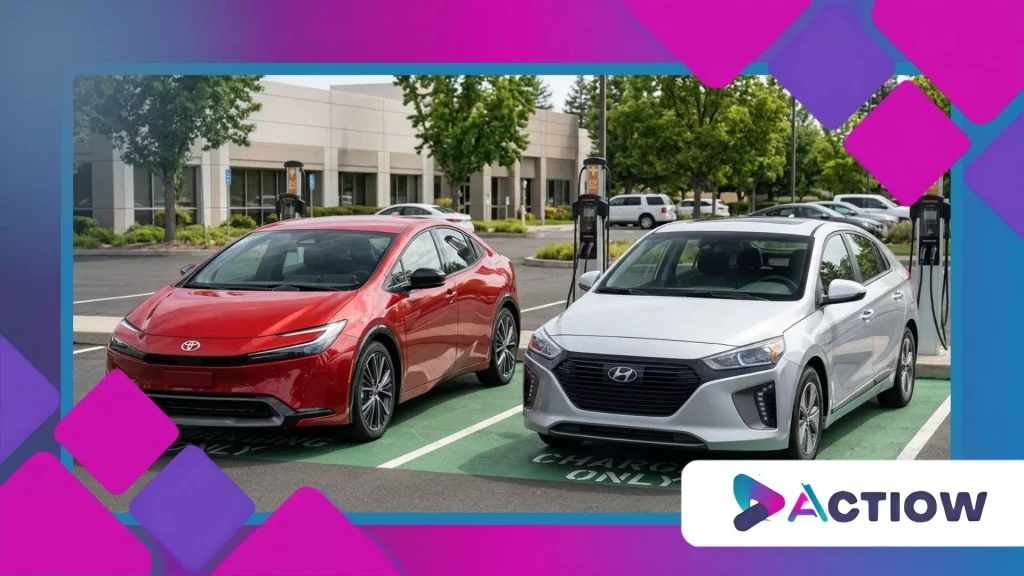
What Is the Core Technology Behind the Toyota Prius Plug-in Hybrid?
Toyota utilizes a refined series-parallel hybrid system paired with a planetary gear e-CVT, optimizing seamless power delivery between the gasoline engine and electric motor.
By integrating a high-capacity lithium-ion battery with a 1.8-liter (or 2.0-liter in newer generations) Atkinson-cycle engine, the system minimizes mechanical losses during low-speed urban driving.
The planetary gear set allows the motor to operate independently during pure electric mode, switching to combined operation effortlessly when acceleration demands increase.
This approach prioritizes continuous engine efficiency over dynamic acceleration feedback, ensuring fuel consumption remains remarkably low under varied road conditions.
Under real-world driving conditions, Toyota’s electric-only operation provides quiet acceleration that satisfies typical city commutes before seamlessly transitioning into hybrid operation.
According to official tests by the U.S. Environmental Protection Agency (EPA), the Prius Prime achieves an impressive 133 MPGe in electric mode and 54 MPG combined in standard hybrid mode.
Regenerative braking recovers kinetic energy efficiently during stop-and-go city traffic, sending power back into the battery to extend driving range without driver intervention.
Consequently, drivers benefit from optimal efficiency without adjusting their driving habits or managing manual gear changes.
++ Jeep Compass EV contre Peugeot E-3008 : quel SUV électrique a la plus grande autonomie ?
How Does the Hyundai Ioniq Plug-in Hybrid Engine System Compare?
Hyundai approaches plug-in efficiency by combining a 1.6-liter GDI Kappa engine with a six-speed dual-clutch transmission (6DCT), delivering a more traditional driving dynamic.
Unlike Toyota’s power-split transmission, Hyundai’s setup directly couples the electric motor to the transmission input shaft, providing crisp gear shifts and responsive acceleration.
This mechanical setup reduces energy conversion friction at higher speeds, making highway driving remarkably efficient for a compact plug-in hybrid.
Furthermore, the light vehicle curb weight allows the system to maximize its 8.9 kWh battery capacity without dragging unnecessary extra pounds.
During daily operation, the Ioniq Plug-in achieves up to 29 miles of pure electric driving, making it highly effective for standard suburban commutes.
The EPA rates the Hyundai Ioniq Plug-in at 119 MPGe and a highly competitive 52 MPG combined once the battery transitions to hybrid mode.
The dual-clutch transmission eliminates the elastic acceleration feel common in traditional CVTs, granting drivers greater throttle control while maintaining high energy recovery efficiency.
As a result, Hyundai offers an engaging driving feel alongside competitive overall efficiency numbers.
Which Vehicle Offers Better Fuel Efficiency and Battery Range?
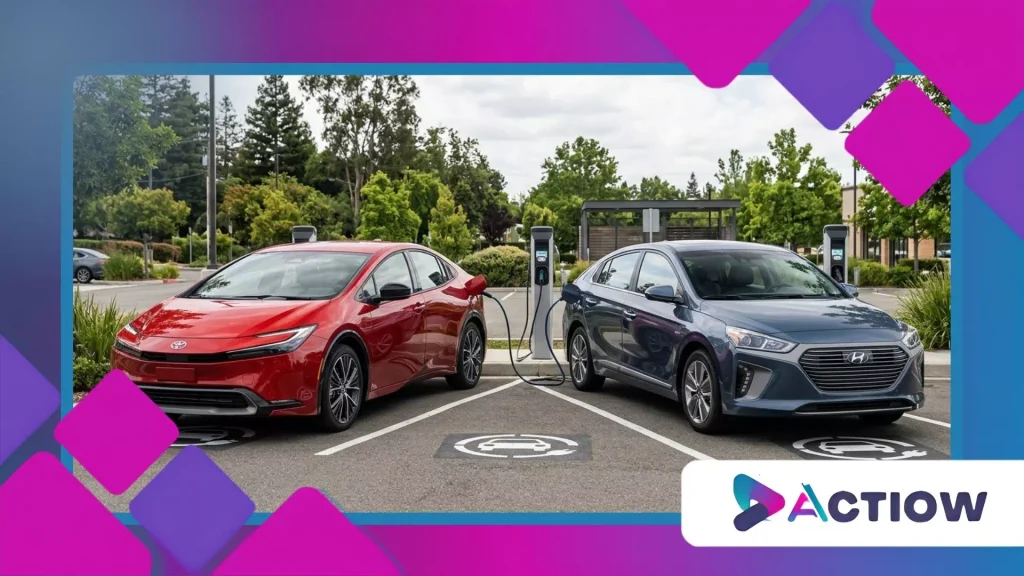
What Is the Real-World All-Electric Range of Each PHEV?
Lors de l'évaluation Toyota Prius Plug-in Hybrid vs Hyundai Ioniq Plug-in models, all-electric range determines how often drivers visit the gas station.
Toyota provides up to 25 to 44 miles of all-electric driving depending on the model generation, allowing many drivers to complete daily errands without consuming gasoline.
Charging the vehicle takes approximately 2.5 hours using a standard 240V Level 2 charger, making overnight or workplace topping-up simple and convenient.
For urban drivers who charge routinely, gasoline engine usage drops dramatically over typical weekly travel.
Hyundai’s Ioniq Plug-in provides a slightly lower all-electric range of approximately 29 miles per full charge, which easily covers short urban trips.
The smaller battery pack recharges quickly, needing under 2 hours and 15 minutes on a Level 2 charging station.
While it offers slightly fewer electric miles than the longest-range Prius variants, its lighter battery weight helps maintain impressive fuel economy after the electric charge depletes.
Therefore, commuters with shorter daily driving routes will find both vehicles equally capable of electric-only operation.
Lire aussi : Toyota Prius contre Honda Insight : L’hybride la plus efficiente pour la conduite quotidienne
How Efficient Are They When Running on Gasoline Hybrid Mode?
Once the battery pack drains, hybrid fuel efficiency determines long-term operating costs during extended highway journeys and road trips.
Is it really worth hauling around a heavy battery pack when driving across long interstate stretches? Toyota’s Atkinson-cycle engine excels in long-haul driving, delivering up to 54 MPG combined in standard hybrid operation.
The planetary gear system constantly optimizes engine RPMs to match speed and load, guaranteeing low fuel consumption across mountains, hills, and open highway corridors.
Hyundai matches this hybrid performance closely, generating 52 MPG combined once its battery charge is fully depleted.
The 6-speed dual-clutch transmission maintains steady gear ratios at highway cruising speeds, preventing high-RPM engine drone and improving highway cruising economy.
Over thousands of annual miles, the thermal efficiency of Hyundai’s engine ensures fuel consumption remains nearly identical to Toyota’s continuous hybrid setup. Consequently, long-distance commuters can rely on either model for low fuel expense.
How Do Overall Ownership Costs Compare Over Time?
What Are the Maintenance Requirements for These Hybrid Systems?
Maintenance requirements play a pivotal role in determining total cost of ownership for both plug-in hybrid vehicles.
Toyota’s e-CVT architecture contains no conventional clutches, alternator, or starter motor, significantly reducing traditional mechanical wear over time.
Regenerative braking systems on the Prius extend brake pad life substantially, often requiring service only after tens of thousands of miles.
Combined with Toyota’s proven long-term battery durability, routine maintenance remains limited primarily to scheduled engine oil changes, tire rotations, and cabin filter replacements.
Hyundai offers exceptional warranty coverage alongside straightforward mechanical architecture to keep ownership expenses predictable.
The dual-clutch transmission requires fluid service over extended intervals, but the clutch pack is designed for long service life alongside the electric motor unit.
Furthermore, Hyundai’s standard 10-year/100,000-mile powertrain warranty provides drivers with peace of mind regarding hybrid battery performance and powertrain longevity.
Thus, both automakers provide highly reliable, low-maintenance vehicles built for long-term daily service.
En savoir plus: Tesla Model Y contre Kia EV6 : quel SUV électrique sera le meilleur en 2026 ?
How Do Depreciation and Long-Term Value Compare for Buyers?
Resale value remains a strong suit for Toyota vehicles due to decades of brand recognition and proven hybrid reliability.
Used Prius Prime models maintain strong demand in second-hand markets, helping owners recover a larger percentage of their initial investment upon resale.
The wide availability of replacement components and specialized hybrid service technicians further protects long-term market value.
As a result, total depreciation costs over five years remain exceptionally low compared to broader automotive industry standards.
The Hyundai Ioniq Plug-in offers a lower initial purchase price on the secondary market, representing an outstanding value proposition for bargain-focused buyers.
While initial depreciation occurs slightly faster than Toyota, the lower entry cost balances out the total money spent over ownership cycles.
Owners who plan to drive the car for several years care less about resale value and benefit more from upfront purchase savings. Therefore, choosing between the two often comes down to upfront value versus long-term resale retention.
Key Technical and Efficiency Specifications
| Feature / Specification | Toyota Prius Plug-in Hybrid | Hyundai Ioniq Plug-in Hybrid |
| EPA Electric Economy (MPGe) | 133 MPGe | 119 MPGe |
| EPA Hybrid Economy (Combined) | 54 MPG | 52 MPG |
| All-Electric Range (Miles) | 25 – 44 Miles (Generation dependent) | 29 Miles |
| Capacité de la batterie (kWh) | 8.8 kWh – 13.6 kWh | 8.9 kWh |
| Type de transmission | Planetary e-CVT | 6-Speed Dual-Clutch (6DCT) |
| Charging Time (Level 2 / 240V) | ~2.5 Hours | ~2.25 Hours |
Toyota Prius vs Hyundai Ioniq: The Ultimate Efficiency Decision
Choosing between these two remarkable plug-in hybrids depends largely on your daily commute length, budget, and driving style preferences.
Drivers seeking maximum all-electric range, higher total MPGe ratings, and legendary long-term resale value will likely lean toward the Prius.
Conversely, commuters who prefer a traditional shifting driving experience, lower initial acquisition costs, and excellent highway efficiency will find the Hyundai Ioniq Plug-in equally compelling.
Ultimately, evaluating a Toyota Prius Plug-in Hybrid vs Hyundai Ioniq Plug-in highlights how mature hybrid engineering can deliver extraordinary mileage and reliability for any eco-conscious driver.
Foire aux questions
Can I drive both vehicles on the highway using only electric power?
Yes, both vehicles can operate entirely on electric power at highway speeds without engaging the gasoline engine.
The Toyota Prius Prime can travel up to 84 mph in pure electric EV mode, while the Hyundai Ioniq Plug-in can reach up to 75 mph on battery power alone.
However, rapid acceleration or steep uphill grades may prompt the gasoline engine to engage automatically to provide additional power.
What happens when the plug-in hybrid battery runs out of charge?
When the plug-in battery reaches its minimum threshold, both vehicles automatically transition into conventional hybrid operation without interrupting drive quality.
The gasoline engine and electric motor work together, using regenerative braking to recharge the battery during deceleration. You can continue driving normally using gasoline until you plug into a charging station again.
Do I need a Level 2 home charger to charge these plug-in hybrids?
A Level 2 home charger is not strictly necessary, as both vehicles include a standard Level 1 (120V) charging cable that plugs into a standard household wall outlet.
A full charge using Level 1 charging takes approximately 5.5 to 7.5 hours overnight. Installing a 240V Level 2 charger simply reduces charging times down to roughly 2.5 hours.
Which model offers better trunk and cargo space for daily use?
The Hyundai Ioniq Plug-in features a hatchback design with a flatter trunk floor, offering approximately 23 cubic feet of cargo space behind the rear seats.
The Toyota Prius Prime accommodates its battery pack slightly higher under the cargo floor, resulting in roughly 19.8 cubic feet of space depending on the model year. Both models include split-folding rear seats to accommodate larger luggage or gear.
How do battery warranties protect buyers over long ownership periods?
Both manufacturers provide robust, long-term battery warranty coverage required by federal and state regulations.
Toyota offers a 10-year or 150,000-mile hybrid battery warranty on newer models, covering manufacturing defects and severe capacity degradation.
Hyundai provides a 10-year or 100,000-mile hybrid battery warranty for original owners, ensuring long-term financial peace of mind.
