
Mazda CX-70 contre Honda Passport : quel SUV intermédiaire offre le meilleur rapport qualité-prix ?
Annonces
Mazda CX-70 vs Honda Passport stands out as one of the sharpest debates among five-passenger midsize SUV shoppers in 2026.
Buyers stepping away from bulky three-row family haulers now demand generous cargo capacity, confident all-wheel-drive traction, and refined cabin comfort without paying luxury-brand markups.
Both Japanese automakers answer this call with distinct philosophies that split drivers into two clear camps.
Annonces
Mazda delivers rear-biased inline-six athleticism and upscale interior craftsmanship, whereas Honda counters with rugged trail readiness and a naturally aspirated V6.
Choosing between these two contenders requires looking past window stickers to examine real-world ownership costs, powertrain efficiency, and everyday usability.
Evaluating midsize crossovers today means weighing hybrid fuel savings against mechanical simplicity and off-road durability.
According to 2026 Edmunds market pricing data, shoppers can secure a base 2026 Mazda CX-70 3.3 Turbo Preferred starting around $42,750 including destination, often discounted by roughly $5,800 through combined dealer markdowns and factory rebates.
Meanwhile, the redesigned 2026 Honda Passport RTL starts near $46,200 MSRP, bringing standard torque-vectoring all-wheel drive and a 10-speed automatic transmission to the table.
Comparing these two vehicles reveals how differently two engineering teams interpret modern automotive value.
Points clés de ce guide
- Pricing and Trim Breakdown: How starting MSRPs, factory incentives, and standard equipment shape upfront affordability across both lineups.
- Engine and Efficiency Analysis: A direct look at Mazda’s mild-hybrid inline-six and plug-in hybrid options versus Honda’s proven 3.5-liter V6.
- Cabin Space and Utility: Practical differences in cargo volume, seat comfort, infotainment interfaces, and urban maneuverability.
- Side-by-Side Specification Chart: Clear numbers comparing horsepower, fuel economy, towing limits, and starting prices.
- Final Buying Verdict and Reader Questions: Actionable guidance to match the right crossover to your driving routine and budget.
How Do Powertrain Performance and Fuel Efficiency Compare?
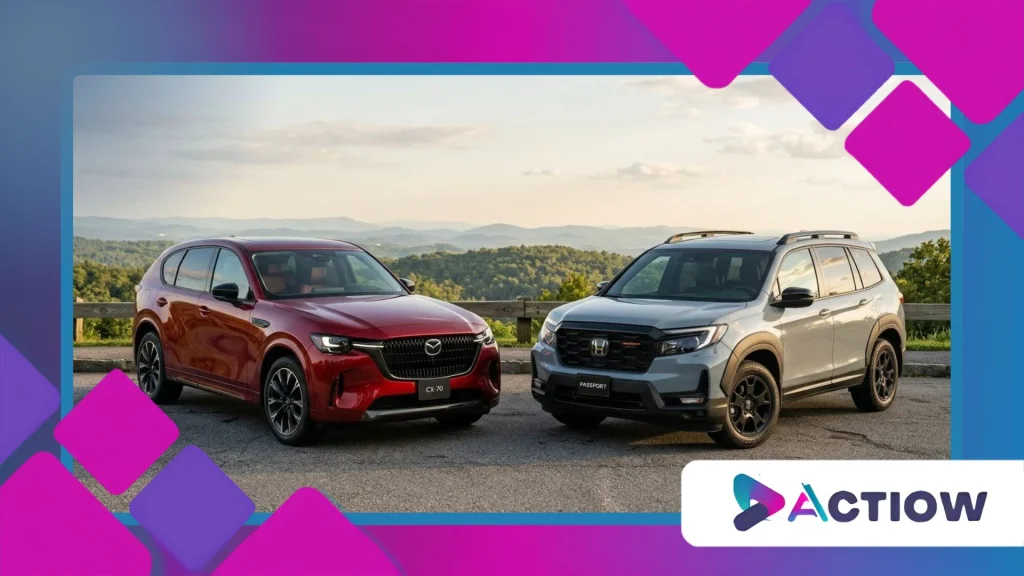
What Engines Power the 2026 Mazda CX-70 Lineup?
Mazda equips the 2026 CX-70 with a longitudinal architecture that feels closer to a German sport sedan than a traditional family crossover.
Standard models house a 3.3-liter turbocharged inline-six paired with a 48-volt mild-hybrid system, generating 280 horsepower and 332 lb-ft of torque.
Stepping up to the Turbo S trims unlocks 340 horsepower and 369 lb-ft of torque on premium fuel. Every version sends power through an eight-speed automatic transmission and standard rear-biased i-Activ all-wheel drive.
Drivers seeking plug-in capability can select the 2026 CX-70 PHEV SC, which pairs a 2.5-liter four-cylinder engine with an electric motor for 323 combined horsepower.
Mazda slashed entry pricing on the 2026 plug-in hybrid to roughly $44,250, making electrified commuting far more attainable than in prior model years.
Standard mild-hybrid trims achieve an EPA-estimated 25 mpg combined, helping owners trim monthly fuel expenses during highway commutes.
Why Does Honda Stick With a Naturally Aspirated V6?
Honda takes an unapologetically mechanical approach under the hood of the 2026 Passport. Rather than adopting small-displacement turbochargers, engineers retained a 3.5-liter direct-injected V6 producing 285 horsepower and 262 lb-ft of torque.
A smooth 10-speed automatic transmission replaces older gearboxes, delivering crisp downshifts when merging onto fast highways or climbing steep mountain passes.
Real-world ownership highlights why many drivers still appreciate this traditional setup.
Consider a family towing a 4,500-pound utility trailer up a rocky forest service road in Colorado; the Passport’s linear throttle response and standard i-VTM4 torque-vectoring all-wheel drive distribute power cleanly without turbo lag.
The trade-off appears at the fuel pump, where the Passport returns 19 mpg city and 25 mpg highway. Still, avoiding high-voltage battery complexity appeals strongly to buyers planning to keep their vehicle past 150,000 miles.
++ BMW i5 vs Mercedes-Benz EQE : Comparatif de berlines électriques de luxe
Which SUV Delivers Better Driving Dynamics on Pavement and Dirt?
Comparer Mazda CX-70 vs Honda Passport behind the wheel feels like choosing between a tailored wool blazer and a waterproof hiking shell.
Mazda tunes its double-wishbone front suspension and multi-link rear setup for sharp turn-in and minimal body roll.
Steering feedback feels weighty and precise, rewarding drivers who enjoy sweeping canyon roads, though firm damping transmits sharp potholes into the cabin.
Honda prioritizes composure over broken asphalt and unpaved trails. The 2026 Passport absorbs expansion joints and gravel washboards effortlessly, especially on TrailSport trims fitted with off-road-tuned dampers, skid plates, and all-terrain tires.
Seven standard drive modes including Sand, Snow, Tow, and Trail allow the Passport to venture well beyond paved campgrounds where the low-slung Mazda would scrape its front bumper.
Which Interior Offers Superior Space, Technology, and Comfort?
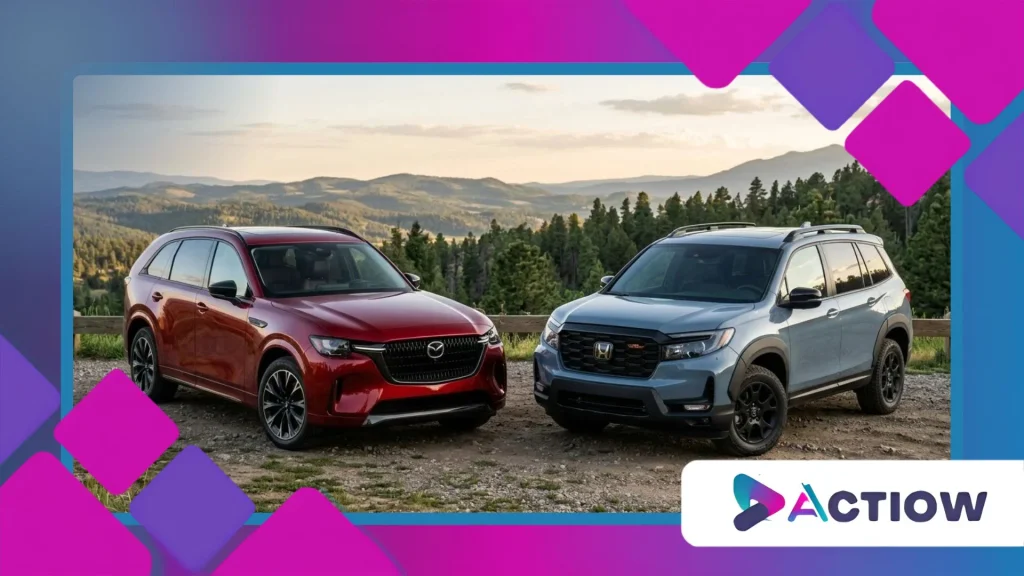
How Practical Is Cargo Capacity and Passenger Room?
Removing the third row creates cavernous interiors in both SUVs, yet their exterior footprints affect daily convenience differently.
Because the CX-70 shares its exact length and width with the three-row CX-90, parallel parking in tight urban garages requires extra patience.
Inside, rear passengers enjoy generous legroom, while standard ventilated front seats and heated rear cushions elevate cold-morning comfort on 2026 trims.
Honda shapes the Passport with shorter rear overhangs and a taller, boxier roofline that maximizes usable volume.
Folding the second row opens up 83.5 cubic feet of cargo space, complemented by a 2.5-cubic-foot underfloor compartment with washable storage bins.
Imagine loading two muddy mountain bikes and camping coolers after a rainy weekend; the Passport’s hard-plastic seatbacks wipe clean in seconds without staining delicate upholstery.
Lire aussi : Toit ouvrant panoramique ou toit standard : avantages à long terme
How Do Cabin Materials and Infotainment Interfaces Differ?
Step inside the CX-70, and you immediately notice near-luxury craftsmanship that punches well above its price bracket.
Higher trims feature quilted Nappa leather, suede dashboard inserts, and two-tone stitched steering wheels that rival vehicles costing $15,000 more.
However, Mazda continues relying on a console-mounted rotary dial rather than full touchscreen functionality while driving, creating a noticeable learning curve for smartphone-centric users.
Honda counters with straightforward ergonomics and durable, family-proof surfaces.
Every 2026 Passport includes a bright 12.3-inch touchscreen with Google built-in, giving drivers instant voice access to Google Maps and media apps without fumbling with physical knobs.
While lower cabin plastics feel more utilitarian than Mazda’s soft-touch trim, physical climate buttons and wide, supportive seats reduce distraction on long interstate journeys.
En savoir plus: Tesla Model Y contre Kia EV6 : quel SUV électrique sera le meilleur en 2026 ?
What Safety Systems Come Standard on Both Models?
Safety technology forms a strong foundation across both lineups, protecting families without requiring expensive option packages.
Mazda equips every CX-70 with blind-spot monitoring, rear cross-traffic alert, adaptive cruise control, and automated emergency braking.
Furthermore, Consumer Reports recognized Mazda as a top-ranked brand for overall vehicle safety, reinforcing buyer confidence in its structural engineering.
Honda includes its updated Honda Sensing suite across every Passport trim, bundling traffic-jam assist, lane-keeping steering support, and road-departure mitigation.
Helpful family touches like rear-seat occupant reminders and rear seatbelt alerts come standard as well.
Neither brand locks essential crash-avoidance sensors behind top-tier trims, ensuring strong baseline protection regardless of your budget.
Where Does True Financial Value Lie Between These Two Crossovers?
How Do Starting Prices and Dealer Discounts Affect Upfront Cost?
Examining real transaction figures shifts the value equation noticeably in 2026.
While the CX-70 3.3 Turbo Preferred carries a $42,750 starting MSRP, slower dealer turn times mean buyers routinely negotiate $2,300 below sticker price plus $3,500 in factory rebates.
Qualified shoppers can also access promotional financing as low as 1.9 percent APR, trimming thousands of dollars in interest charges over a five-year loan.
By contrast, the redesigned 2026 Honda Passport commands firmer pricing on dealership lots due to fresh styling and loyal repeat buyers.
Starting at $46,200 for the RTL and climbing to $49,900 for the TrailSport, the Passport asks for more money upfront before incentives.
Consequently, budget-conscious buyers shopping for Mazda CX-70 vs Honda Passport often find they can step into a mid-tier CX-70 Turbo Premium for less than a base Passport RTL.
Which Midsize SUV Holds Stronger Long-Term Resale and Ownership Value?
Upfront discounts only tell half the financial story over a seven-year ownership window.
Honda enjoys legendary resale retention in the midsize SUV segment, driven by strong demand for naturally aspirated V6 crossovers on the used market.
Routine maintenance remains predictable, and independent mechanics everywhere know how to service Honda’s 3.5-liter engine.
Mazda offsets slightly steeper early depreciation through superior daily fuel efficiency and lower initial purchase prices.
Over 15,000 annual miles, the CX-70’s 25 mpg combined rating saves roughly $450 to $600 per year in gasoline compared to the thirstier Passport.
Buyers who drive high highway mileage capture immediate operational savings, whereas weekend adventurers benefit from Honda’s slower value drop at trade-in time.
Should You Buy the Mazda CX-70 or the Honda Passport?
Your daily environment ultimately decides which crossover rewards your investment most.
If your routine revolves around paved commuter routes, client meetings, and desire for upscale interior ambiance, the CX-70 delivers unmatched refinement per dollar.
Why pay luxury-marque prices when Mazda wraps inline-six smoothness and Nappa leather into an attainable midsize package?
Conversely, if your weekends involve unpaved trailheads, winter ski trips, and hauling bulky outdoor gear, the Passport justifies every penny of its higher entry price.
Its boxy cargo bay, standard torque-vectoring all-wheel drive, and Google-powered touchscreen make life effortless for active households.
Both vehicles excel at their respective missions without forcing buyers into unwanted third-row seats.
2026 Specification and Value Comparison
| Caractéristiques / Spécifications | 2026 Mazda CX-70 (3.3 Turbo / PHEV) | 2026 Honda Passport (RTL / TrailSport) |
| Starting MSRP (with destination) | $42,750 (Preferred) / $44,450 (PHEV SC) | $46,200 (RTL) / $49,900 (TrailSport) |
| Standard Engine | 3.3L Turbo Inline-6 Mild Hybrid (280 hp) | 3.5L Naturally Aspirated V6 (285 hp) |
| Optional Powertrain | 340-hp Turbo S Inline-6 / 323-hp PHEV | None (Single V6 across all trims) |
| Transmission & Drivetrain | 8-Speed Automatic / Standard AWD | 10-Speed Automatic / Standard i-VTM4 AWD |
| Combined Fuel Economy | 25 MPG (Mild Hybrid) / 56 MPGe (PHEV) | 21 MPG Combined (19 City / 25 Hwy) |
| Maximum Towing Capacity | 5,000 lbs (Premium trims and above) | 5,000 lbs (When properly equipped) |
| Espace de chargement maximal | 75.3 cu. ft. (Rear seats folded) | 83.5 cu. ft. (Includes underfloor bins) |
| Infotainment Display | 12.3-inch Screen with Rotary Controller | 12.3-inch Touchscreen with Google Built-In |
Choosing the Right Two-Row Midsize SUV for Your Driveway
Settling the Mazda CX-70 vs Honda Passport question comes down to matching engineering strengths with your real lifestyle rather than chasing spec-sheet bragging rights.
Mazda wins decisively on upfront transaction pricing, inline-six sophistication, fuel economy, and near-luxury cabin materials.
Meanwhile, Honda claims clear superiority in cargo versatility, off-road capability, intuitive touchscreen technology, and long-term resale resilience.
Before visiting a dealership, test-drive both vehicles back-to-back on familiar roads so you can feel how Mazda’s firm suspension compares against Honda’s compliant ride.
Check current local rebates and financing rates, as manufacturer incentives can swing total ownership costs by thousands of dollars.
Which qualities matter more in your next daily driver sporty luxury refinement or rugged trail capability? Share your thoughts and test-drive experiences in the comments below!
Foire aux questions
1. Does the 2026 Mazda CX-70 have a third row of seats?
No, the 2026 Mazda CX-70 is strictly a five-passenger, two-row midsize SUV.
Although it shares its exterior platform and dimensions with the three-row CX-90, Mazda removed the rear bench to create deeper cargo space and underfloor storage compartments.
2. Which SUV has more cargo room, the Mazda CX-70 or the Honda Passport?
The 2026 Honda Passport offers noticeably more maximum cargo capacity at 83.5 cubic feet with the second row folded flat, compared to roughly 75.3 cubic feet in the Mazda CX-70. Honda also provides a wider cargo opening and washable underfloor storage bins suited for bulky outdoor gear.
3. Can both the Mazda CX-70 and Honda Passport tow 5,000 pounds?
Yes, both midsize SUVs achieve a maximum towing rating of 5,000 pounds when properly equipped.
However, buyers should note that entry-level CX-70 Turbo Preferred models cap out at 3,500 pounds, requiring a step up to the Turbo Premium trim or higher for full 5,000-pound towing capability.
4. Is the Mazda CX-70 Plug-In Hybrid worth buying over the Honda Passport?
For drivers with short daily commutes and home charging access, the 2026 CX-70 PHEV SC represents compelling value following Mazda’s substantial price reduction to $44,250.
Since Honda does not offer a hybrid Passport for 2026, commuters looking to minimize gasoline stops will save significantly with Mazda’s electrified powertrain.
5. Which vehicle is easier to park in tight city spaces?
The 2026 Honda Passport is noticeably easier to maneuver and park in crowded urban lots because it measures several inches shorter overall than the Mazda CX-70.
Light low-speed steering and shorter rear overhangs give the Passport a distinct agility advantage in tight garages.
